

Hidden Flames – Chapter XIII Where the Past Ends

Lucas
The farm usually breathed.
Now it was holding its breath.
There was no storm in the sky, no cloud of dust rolling in from the hills, and yet something vibrated in the air. The boards of the paddock stood as they always had, the wind moved through the grass the same way it always did, but every sound felt tighter, as if the land itself knew what was coming.
Nathan knew.
And so did I.
I had seen it on him for days. Not in the big things, but in the small ones. In the way he drank a sip of water too quickly. In the way his shoulders lifted just a fraction when I said his name. In the way he didn’t fully sleep at night, only lay there, his body tense, as if he might need to defend himself at any moment.

I didn’t keep asking questions.
Nathan didn’t calm down from words. He calmed down from presence.
So I stayed close.
My hand on his waist when he passed by me. My fingers at the nape of his neck when he stared at nothing for too long. My forehead pressed to his when I saw him slipping back to that place he had fought so hard to climb out of.
“I’m here,” I told him again and again. Not loudly. Not ceremoniously. The way a person breathes.
And he held on to me.
Not weakly. Not desperately.
But like someone who knew he didn’t have to face this alone anymore.
The day of the visit was approaching.
His mother.
And George.
George’s name alone was enough to change Nathan’s body. I had seen this kind of reaction before. It wasn’t anger. It wasn’t fear. It was that deep, learned tension a person carries when they’ve been taught for years that they are less. That their feelings are ridiculous. That their body is wrong. That their worth only exists as long as they obey.
George never hit.
George destroyed.
Carefully. Consistently. Always with a sentence ready to justify everything.
“I only want what’s best for you.”
“I’m making you stronger.”
“I’m turning you into a man.”
And I knew exactly what I was going to say to him.
Not with rage. Not by shouting. Not the way he would expect.
But precisely. Clearly. Inescapably.
I knew where George truly hurt: where control no longer worked. Where the illusion of power collapsed.
And Nathan’s mother…
I was prepared for her too.
Not because I hated her.
But because there were no excuses left.
A mother who chooses her own safety over her child’s reality cannot remain untouched. Years of silence traded for financial security. Sentences left unsaid. Eyes deliberately turned away. These are not neutral choices.
And Nathan knew it.
I could see it in the evenings, the way he assembled himself from the inside. The way he rehearsed the words he would say. The hardest ones. The ones George had never heard from him.
That he was in love with me.
That it wasn’t shameful.
That it wasn’t a mistake.
That it wasn’t a passing whim.
George believed that “friends” lived on the farm.
A respectable, heterosexual story, complete with women. Nathan’s mother had lied to him. She knew how deeply George hated anything that didn’t fit into his world.
But the time for lies was over.
That evening, Nathan curled into my arms, his voice quiet but clear.
“I don’t want to hide anymore,” he said. “If I don’t say it now, I never will.”
I kissed his hair.
Not to encourage him.
But to remind him.
He would not stand there alone.
He would not speak alone.
He would not face those who once broke him alone.
And as darkness fell over the farm, I knew this would not be just a visit.
This was reckoning.
Morning came too early.
Not because of an alarm. On a farm, you don’t need clocks. The body knows when it must wake. And yet it felt as if time itself had arrived before we were ready.
Nathan was already awake.
He didn’t move, just lay there beside me, his back tense against my chest. This wasn’t sleep. It was readiness. The kind of wakefulness that comes after fighting the first battle hours before dawn.
I slowly placed my arm around his waist. Not tightly. Just enough to say
I’m here.
He stiffened for a moment, then released. A tiny movement. One no one else would notice. But I did. Always.
The house was quiet. Too quiet. Not the peaceful stillness of morning, but the kind that feels watchful. The crackle of wood, the soft hum of the refrigerator, distant birds all of it sounded sharper than usual. As if the world itself were waiting.

Nathan sat on the edge of the bed.
He didn’t look at me. He stared at the floor, laced his fingers together, then separated them. The same motion again and again. I had seen it before. It was what he did when his thoughts grew too loud.
“I’ll make coffee,” he said.
It wasn’t a question.
It was escape.
I got up with him. In the bathroom, he paused in front of the mirror. I saw that quiet internal reckoning on his face. As if he were checking whether he was still there. As if he were asking himself: will I be enough today?
I stepped behind him, placed my hand on his shoulder. I didn’t speak. Our eyes met in the mirror.
There was no panic there.
Only determination.
And pain.
In the kitchen, every movement was too precise. Nathan poured water too fast. Set the cup down too hard. His nerves were drawn tight, and every sound became louder because of it.
I sat at the table and watched.
His hand trembled for a split second as he poured the coffee. Barely noticeable. Enough for me to see. I stepped in and took the pot from him.
“Let me,” I said softly. “I’ve got it.”
He didn’t protest. That alone said everything.
Outside, the farm slowly woke. Sunlight glinted off the paddock. The smell of earth drifted through the open door. Everything looked the same as yesterday. And yet it wasn’t. It felt like the last morning of an old life.
Nathan finally sat across from me.
He wrapped both hands around his mug but didn’t drink. His gaze drifted past the window, toward the road where they would soon appear.
“I’m going to say it today,” he said at last.
He wasn’t asking.
He wasn’t seeking reassurance.
He was stating a fact.
I nodded.
“I know.”
“If he starts yelling…” He paused. “If he tries to humiliate me…”
I stood, walked over, and knelt in front of him so we were at eye level. I placed my hands on his face.
“Then I’ll be there,” I said slowly. “And you won’t fall back. I won’t let you.”
Something filled his eyes—not tears. Release.
“I’m scared,” he finally said.
“I know.”
“But I’m not backing down.”
I smiled. Not brightly. Proudly.
“That’s the difference between the old Nathan and the man you are now,” I said. “The old one stood alone. This one doesn’t.”
We sat like that for a while. No more words were needed. The silence shifted. It wasn’t friendly but it was manageable.
Outside, there was still no sound of a car.
But it was close.
And we were ready.
The sound of the car arrived before the car itself.
Tires crunched over gravel, slow and deliberate, as if the person arriving wasn’t a guest but someone who believed he had every right to be here. Nathan stiffened beside me. He didn’t step forward. He didn’t step back. He simply stood.
I watched his shoulders. His breathing. His jaw.
The car stopped.
For a moment, no one got out. That was George’s kind of pause. Time given so everyone else could adjust.
His mother stepped out first.
The same careful movement Nathan had known since childhood. Slightly too controlled, as if she were always aware of being watched. Her hair was neatly arranged, a smile attempted on her face, but her eyes darted nervously. She saw us, and her gaze caught on Nathan for a split second.
Something passed through her.
Guilt? Fear? Delay?
I couldn’t tell.
George got out more slowly. Almost ceremoniously. He straightened his back and surveyed the farm as if already taking inventory. That faint, superior smile sat at the corner of his mouth—the smile of someone who always knows better. Who has already decided what he thinks.
His eyes landed on me first.
He sized me up.
Not greeting.
Not curiosity.
Assessment.
Then he looked at Nathan.
And something halted inside him.
Not surprise.
Recognition.
The kind that comes when you realize the person in front of you is no longer who you expected.
Nathan stepped forward.
One single step. But with it, his entire body placed itself there. Not behind me. Not tucked beside me.
In front.
George extended his hand.
The gesture was too firm, too deliberate, as if he meant to assert dominance even in a handshake. Nathan accepted it.
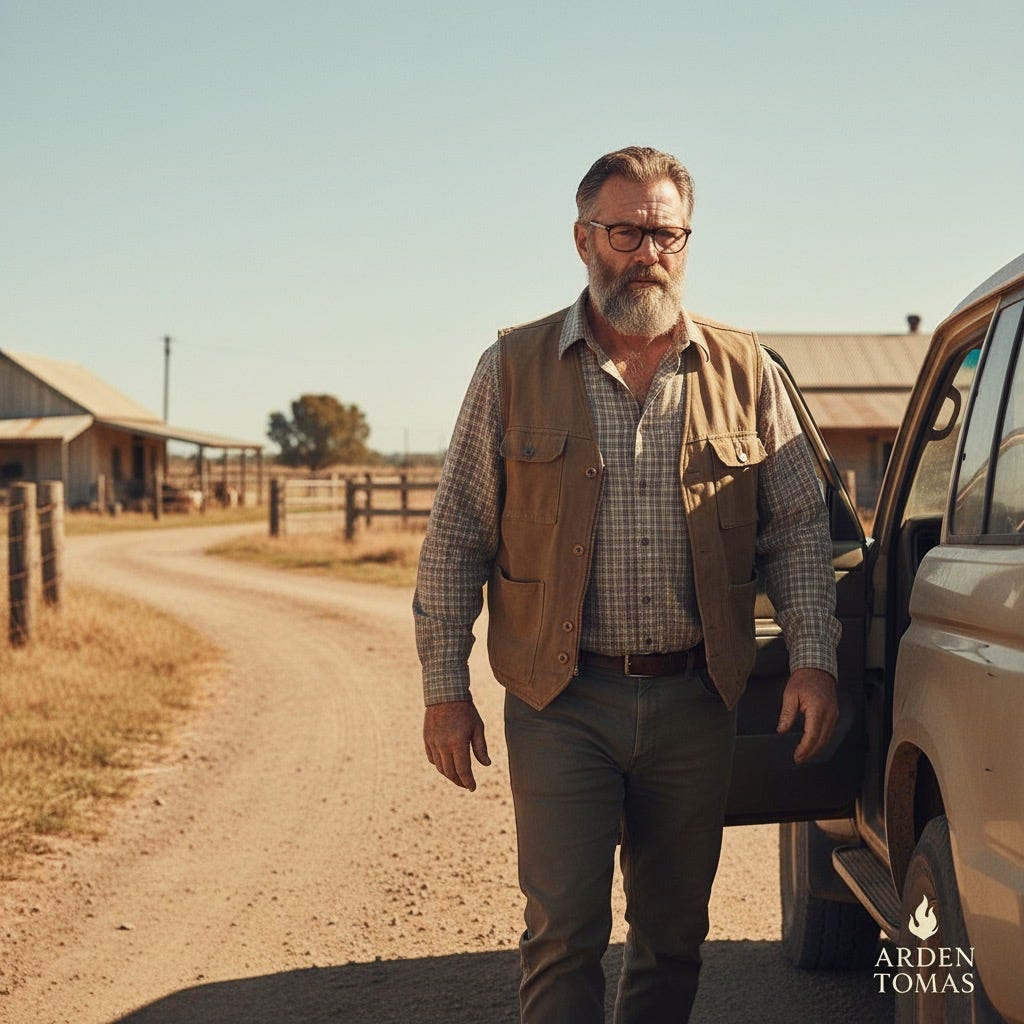
The handshake was brief.
But it said everything.
George squeezed. Tested. Nathan didn’t pull away. Didn’t collapse. He held.
Their eyes met.
George’s gaze was cold, as always. But now there was something new in it. Caution. As if he were suddenly unsure of his footing.
That’s when Nathan’s mother stepped closer.
“Nathan,” she said, and hugged him.
The hug was too quick. Too light. There was no time inside it. Nathan hugged her back, but his arms stayed stiff. I could see it wasn’t for him. It was performance.
George turned to me.
“George,” he said. “You must be Lucas.”
It wasn’t a question.
“Yes,” I replied.
Our hands met. He squeezed. So did I. Not from force. From calm.
His eyes narrowed slightly.
“Nice place,” he said. “Plenty of space.”
Nathan stepped beside me.
And then it happened.
No shouting.
No accusation.
No explosion.
Just one sentence.
“Before you say anything else, George,” Nathan said. His voice was calm. Clearer than I had ever heard it. “There’s something you need to know.”
His mother froze.
George slowly turned toward him.
“Yes?”
Nathan didn’t look at him immediately. He glanced at me first. Just for a moment. Not for support confirmation.
Then he met George’s eyes.
“Lucas isn’t my friend,” he said. “He’s my partner. The man I love. And the man I live with.”
The air stopped.
No birds. No wind. Even the farm held its breath.
George’s face went blank.
Then, very slowly, it tightened.
And I knew there was no way back.
George didn’t explode right away.
That surprised me most.
He simply stared at Nathan. Longer than appropriate. As if this wasn’t the first time he’d heard the truth—but the first time he was forced to admit it had always been there.
“Somewhere…” he began slowly, his voice rough, “somewhere I suspected.”
He glanced at Nathan’s mother, as if seeking confirmation. He got none.
“You know what your problem is?” he continued, turning back to Nathan. “You were never willing to become what you were supposed to be.”
My stomach tightened.
“I did everything,” George said. “Discipline. Work. Strength. I thought it could be trained out of you. I wanted to make a man out of you.”
Nathan didn’t move. Didn’t retreat. But I could see how deeply it hurt.
“And I failed,” George added bitterly. “That’s my shame.”
That was when I stepped forward.
Not quickly.
Not angrily.
Deliberately.
“No,” I said quietly. “That wasn’t failure.”
George looked at me, anger flashing in his eyes.
“What you did to Nathan for years,” I continued, “was abuse. Psychological terror. Humiliation. Intimidation. Not parenting.”
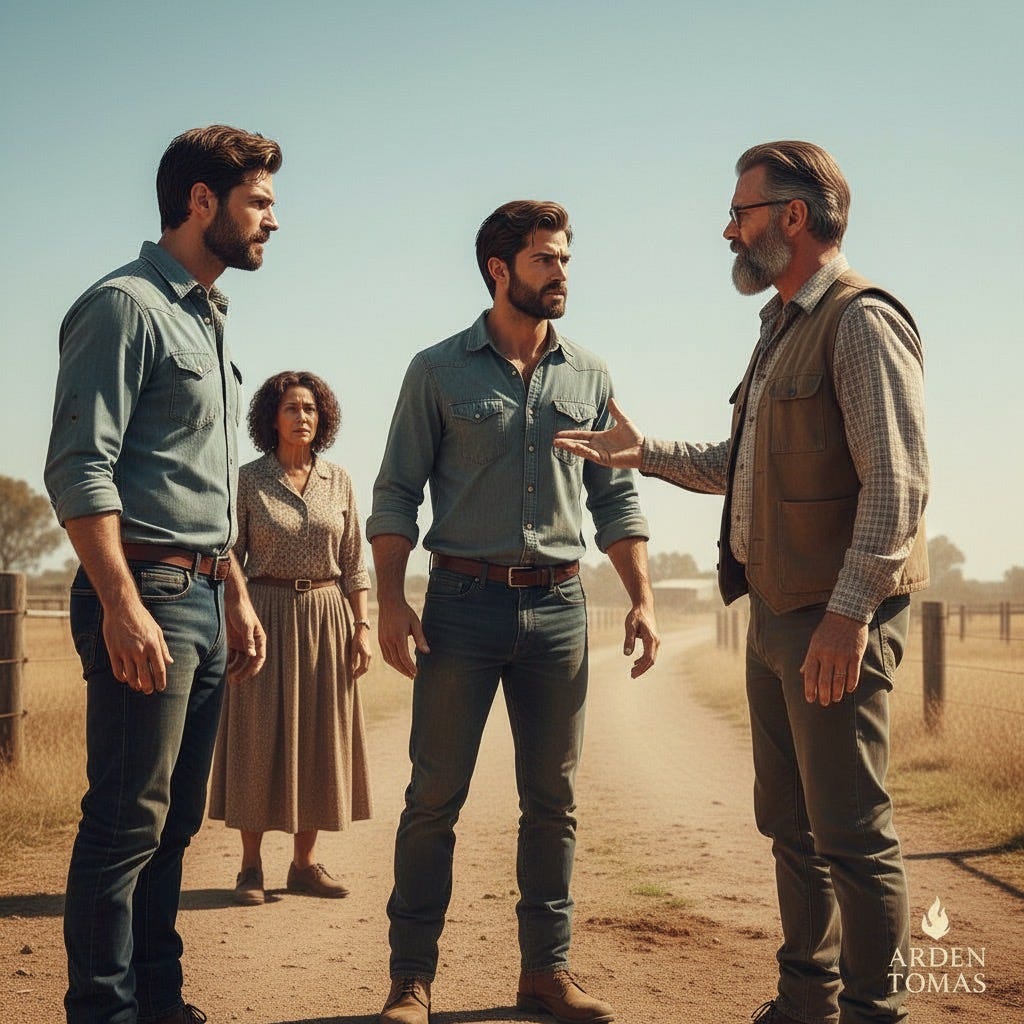
My voice stayed calm. That made it dangerous.
“You did it to a child,” I said. “A defenseless child. And if there is such a thing as justice, you will answer for it. Maybe not today. Maybe not here. But you won’t escape it.”
George’s face twisted.
“Don’t you lecture me!” he shouted, stepping closer.
His hand moved.
Instinct kicked in. I stepped aside, caught his wrist, twisted, and pinned it. I didn’t hit him. I didn’t need to. He felt a kind of strength he had never known with Nathan.
“That’s enough,” I said quietly into his ear. “You leave. Now.”
I released him, but my body still blocked his path.
“You get in your car,” I continued, “and you drive away. And you never set foot here again. If you come back, I won’t be this patient.”
George looked at me.
He knew.
He felt it.
Without a word, he turned and walked back to the car.
The door slammed.
His mother stayed.
She stood there. Trembling. Looking at us. At her son.
I turned to her.
“You can stay,” I said. Not threatening. Not pleading. Clear. “If you want.”
Nathan stepped beside me.
“For the first time, you get to choose,” I continued. “Not money. Not fear. Not habit.”
“You stand with your son,” I said slowly, “or you follow the man who took his childhood away.”
Silence fell.
The kind of silence with nowhere left to hide.
She didn’t answer right away.
She looked at George’s car, the engine still running, as if buying herself time. Then she looked at Nathan. Not for long. She couldn’t hold it. Her gaze slid away, as if his eyes contained too much she would finally have to understand.
“I…” she began, then faltered.
She didn’t cry.
She didn’t apologize.
She didn’t truly explain.
“I can’t do this like this,” she said at last. “I can’t turn everything upside down overnight.”
That was her decision.
Unspoken, but unmistakable.
She chose the past.
The familiar.
The fear.
The man she believed she couldn’t survive without.
“He…” she tried again, but the sentence never landed. “He gave us a lot.”
Nathan didn’t move.
“And he took a lot away,” he said quietly. Not accusing. Not angry. Simply true.
She didn’t answer that either. She adjusted her coat, as if preparing for an ordinary departure. As if something hadn’t just ended forever.
“Take care of yourself,” she said to Nathan.
That was all.
She turned and walked to the car.
She didn’t look back.
That was when Nathan reacted for the first time.
He didn’t collapse.
He didn’t shout after her.
He didn’t run.
He simply let out the breath he had been holding for years.
“That’s it,” he said.
Not a question. Not relief. Recognition.
I walked toward him, but I didn’t touch him right away. I let the feeling move through him.
“I knew,” he continued. “Somewhere I always knew. I just hoped that one day…” He trailed off.
His shoulders didn’t shake. They dropped. As if they no longer had to hold anything up.
“She didn’t stay,” he said again. “And this was the first time she really could have.”
“Yes,” I said. “And this was the first time you didn’t step back.”
He looked at me. Pain was there—but no self-blame.
“It’s strange,” he said. “How it hurts this much… and still feels lighter.”
That was when I pulled him into me.
Not tightly.
Not protectively.
The way two grown men stand together when one has finally spoken the truth.
“You didn’t lose someone today,” I said softly. “She lost you.”
Nathan didn’t reply. He just nodded.
The silence after the visit was unlike any we’d known before.
Not tense.
Not storm-laden.
Deep.
The sounds of the farm slowly returned. Wind through trees. A distant animal call. Life moved on as if nothing had happened.
And yet everything had changed.
Nathan sat on the veranda. He wasn’t looking at anything in particular. Just sitting. I was beside him.
We didn’t speak.
We didn’t need to.
This silence wasn’t punishment.
It wasn’t absence.
It was space.
A place where the question of who had to bend no longer existed.
Nathan finally spoke.
“I understand now,” he said. “Why it was always so hard to breathe.”
I didn’t answer right away.
“Is it easier now?” I asked eventually.
He thought about it.
“It’s not easy,” he said. “But it’s clean.”
That was the word.
Clean.
And in that clarity, for the first time, it wasn’t the past deciding—but what lay ahead.
We stayed there as the sun sank lower. The farm breathed again.
And I knew that what we had closed today wasn’t a chapter.
It was a shackle.
I didn’t wait until full darkness.
The sun hung low, painting golden lines across the veranda boards. That kind of light that doesn’t rush. That stays. Nathan was still sitting where he had been. His body was tired, but no longer tense. As if something had finally fallen away.
I sat across from him.
I didn’t kneel right away.
First, I just looked at him. At his face as it was now. Not defensive. Not waiting. Simply present.
“You know,” I began, “I would have done this anyway.”
He looked up at me.
“Even if they’d stayed,” I continued. “Even if they hadn’t. Even if nothing at all had happened today.”
A cautious question flickered in his eyes.
“Because this wasn’t a reaction to today,” I said. “This was a decision. Old. Conscious. Earned.”
I stood.
Now I knelt in front of him.
Not theatrically.
Not ceremonially.
The way a man lowers himself when he wants no more misunderstandings.
“Nathan,” I said softly. “I don’t love you because you became strong. And I don’t love you because you finally said who you are.”
I took his hand.
“I love you because you survived all of this and still know how to love. Because you didn’t harden into the thing that hurt you. Because despite everything, you kept your gentleness.”
His throat moved. He didn’t cry yet.
“I want to live with you,” I continued. “Not hiding. Not explaining. Not halfway. Fully.”
I took out the ring.
It wasn’t flashy. It didn’t need to prove anything. It was exactly what I’d chosen for him: simple. Strong. Enduring.
“I want there to be a place in this world where you never have to step back again,” I said. “A home where you don’t have to prove yourself. Where there is no fear. Where staying is never a question.”
I looked up at him.
“Will you marry me?”
That was when Nathan cried.
Not loudly.
Not breaking.
The way a person cries when they no longer have to hold themselves together.
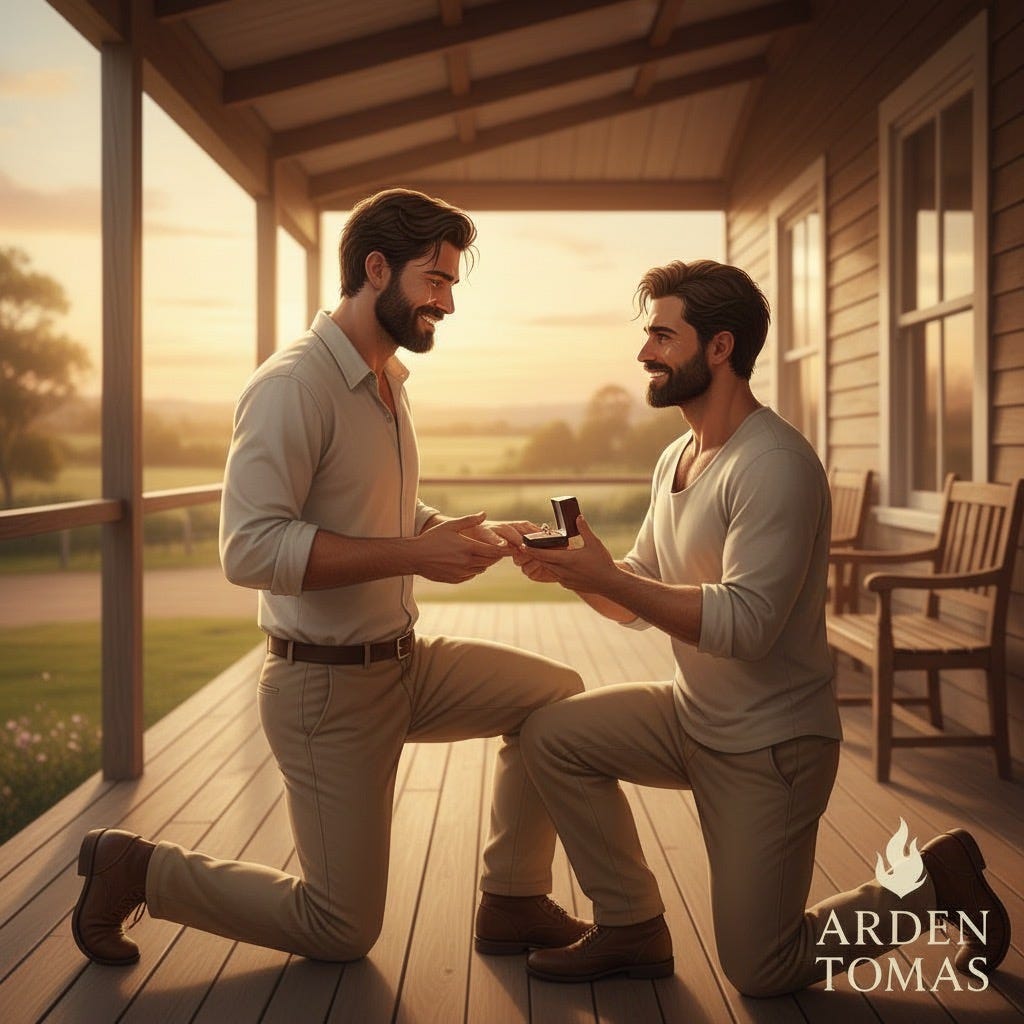
He knelt in front of me before answering. He cupped my face.
“Do you know what’s strangest?” he asked, his voice breaking. “I spent my whole life afraid of being abandoned… and now someone is asking me to stay.”
He nodded.
“Yes,” he said. “Yes. With you. Always.”
When I slid the ring onto his finger, there was no applause. No shouting.
Just silence.
But this silence was full.
I kissed him. Slowly. Deeply. Not rushing. Not proving.
The sun disappeared beyond the horizon. The farm darkened, but in the light of the veranda we stood there together, bound by something no one could ever take from us.
Nathan rested his forehead against mine.
“Now I understand,” he said. “What it means to be chosen.”
And in that moment, I knew:
This was not the end of a story.
This was the beginning of a life.
Beautiful story. 👍🏻💪🏻❤️💯‼️