

Hidden Flames Chapter XXVIII — The Weight of Silence
M/M Romance

Hidden Flames Chapter XXVIII — The Weight of Silence
The morning didn't come the way it should have.
Nathan was already awake before dawn — or perhaps he had never slept at all. He couldn't be sure. The boundary between night and dawn had blurred, as if the canvas walls of the tent couldn't hold back the darkness but instead let the grayness seep through, drop by drop, like a slow bleeding.
Lucas's breathing beside him was steady, deep and calm — the rhythm of sleep to which Nathan had no key. He watched it for a while. Counted the breaths. One, two, three. With each exhale, Lucas's ribs expanded a little wider, then closed again. Nathan envied that ease — the ability to surrender to sleep when the world was still burning.
Carefully, so as not to wake Lucas, Nathan slipped out from under the blanket. The sand was cold beneath his feet. He picked up his shirt from the ground, pulled it on, and stepped outside the tent.
The island was quiet. Not yesterday's silence — that silence, the one that settled over them after the beating and the confession, had been heavy, like wet sand. This silence was different. Emptier. As if the island itself were holding its breath, waiting for what came next.
Nathan walked down to the shore. The water was smooth, almost oily in the dawn light. There were no waves. No wind. Just the water and the stillness and the slowly brightening sky, which promised nothing — no sun, no storm, just light that came because it had to come.

He sat down in the sand, at the water's edge. The waves — which eventually came, slowly, almost reluctantly — reached his feet, then pulled back. Nathan watched them. Tried to feel something. Anger. Pain. Grief. Anything.
Nothing.
Just the silence.
Lucas woke when the sun was already high. The tent was empty — the blanket beside him folded back, as if Nathan had done it carefully, deliberately. The candles — the ones that had burned last night while they fell asleep — had melted down to stubs, trails of wax pooled in the sand. Lucas lay still for a moment, watching the emptiness beside him. The space where Nathan should have been.
He got up. Got dressed. Went outside.
He found Nathan on the shore. Sitting where Lucas had guessed he would be — at the water's edge, knees drawn up, arms wrapped around them. His shirt was damp with dew, but he didn't seem to notice. Lucas stood at the tent entrance and just watched him. The distance wasn't great — maybe twenty steps — but Nathan was as far away as if he were sitting on another island. In another world, where Lucas couldn't reach him.
Lucas made coffee. At their little campsite, at the fire pit where they'd built a fire last night, he started a new one. The water boiled. The coffee powder spread through the mug like a dark cloud. Lucas's hands didn't shake — or at least, he didn't feel them shaking. But something inside, deep in his chest, held a tension that wouldn't release. Not the tension of fear — but of helplessness.
He carried two mugs down to the shore. Sat down in the sand beside Nathan. The coffee steamed. Nathan didn't move.
"Here's your coffee," Lucas said quietly.
Nathan nodded. He didn't take the mug.

Lucas didn't push it. He set the mug down beside him in the sand and waited. The waves came and went. The sun climbed higher. The silence between them wasn't hostile — but it wasn't friendly either. Just silence. Between two people who had shared everything with each other, the one thing they shared now was the wordless emptiness.
Márk's boat arrived mid-morning.
The engine sound was distant at first, then grew louder, until it cut through the island's silence like a knife through canvas. Nathan didn't even look up. Lucas watched from the shore as the boat docked and Márk stepped out, followed by two new workers — younger, quieter, shorter than Frank. No tattoos. No oily smile. Just two men who had come to work.
Márk walked over to Lucas. His face was heavy with concern, his eyes dark.
"Lucas," he said quietly. "How are you?"
Lucas didn't answer the question. "When can we continue?"
Márk nodded, understanding. "Right now. The guys are ready." He hesitated. "Nathan...?"
"He needs time."
Márk didn't ask anything else. He went back to the workers, and the day's order began: hammering, sawing, shouting. The island filled with noise, and Nathan still sat on the shore, the coffee cooling untouched beside him.
Around noon, Nathan finally stood up. He didn't say anything to Lucas — he didn't need to. He went into the tent, took out his phone, and sat down on the blanket. The screen's glow lit up his face, which was expressionless, like a mask.
The first call went to the lawyer.
Her name was Aline Reyes. Mid-forties, sharp, her voice like ice water — not unfriendly, but not warm either. Exactly the kind of lawyer Nathan wanted: someone who didn't feel, only thought.
Nathan laid out the facts. Frank's confession. George's instructions from prison. His mother's meeting with Frank after his release. The money she'd delivered on George's behalf. His voice was even throughout, almost mechanical, as if he were reading a report rather than recounting his own life.
Aline listened. Then she spoke: "The confession holds for now. But I have to warn you — if Frank recants, or if George's lawyers apply enough pressure, the charges against your mother will be hard to prove. It comes down to his word."
"And if he doesn't recant?"
"Then we have a chance. But proving manipulation from inside a prison is complicated. George has connections. This won't be quick, Nathan."
Nathan nodded, though Aline couldn't see him. "I don't care how long it takes."
Aline was silent for a moment. "All right. I'll start the proceedings. But there's something else: your mother's lawyer has already called me."
Nathan's stomach clenched. "When?"
"This morning. They're claiming your mother didn't know about Frank's intentions. That George misled her. That she's a victim too."
Nathan said nothing. The silence on the line was so thick it was almost tangible.
"Nathan? Are you there?"
"Yes," Nathan said. His voice didn't shake — not anymore. "Go ahead. Everything you can."
He hung up. His hand dropped to his thigh, and for a moment he stayed perfectly still. Then he leaned forward, buried his face in his palms, and did nothing. He didn't cry. He didn't scream. He just sat there, and the weight of silence pressed down on him like a stone slab that couldn't be lifted, only endured.
Lucas was working on the hilltop. The blueprint was in his hands, the pencil clamped between his teeth. He stood beside Márk, marking the foundations for the bungalows. The workers hauled stones. The sun burned the skin. Lucas was sweating, his shirt clinging to his back, but he didn't feel the heat — only the work. The physical motions that, for an hour at least, pulled his focus elsewhere.
But his eyes kept drifting back to Nathan. Nathan was sitting on the shore, in front of the tent, the phone at his ear. Lucas couldn't hear what he was saying. He only saw his face — the mask-like emptiness, the motionless lips, the face buried in his palms.
Lucas's pencil stopped on the blueprint. The line he was about to draw didn't happen.
Márk noticed. He said nothing. Just waited.
Lucas turned back to the blueprint. The line got drawn. Then the next one. And the next. The work continued, and Lucas let the rhythm carry him — hammering, sawing, shouting — while his heart beat a different rhythm, slower, heavier.
The call came in the afternoon.
Nathan was sitting in the tent, the phone in his lap. A name flashed on the screen — a name he didn't want to look at, but couldn't not look at.
Mom.
Nathan's finger hovered over the green button. Then he pressed it.
"Nathan! Darling! How are you?"
His mother's voice was sweet — the kind of sweet Nathan had known his entire childhood. The voice that sang lullabies, that tied his shoes, that soothed him when he had nightmares. The voice that now, in this moment, pierced Nathan's ear like a needle driven slowly, deliberately, under his skin.
Nathan didn't answer the question. "I know what you did."
Silence on the other end. Not the silence of surprise — but of preparation. His mother had been waiting.
"George forced me," she said. Her voice shifted — the sweetness was gone, replaced by defensiveness, sharp and clicking like a lock engaging. "I'm a victim too, Nathan. I didn't know what Frank wanted. He just told me to meet him, to hand over an envelope. I didn't know what was inside."
"You didn't know," Nathan repeated. His voice was empty, like the shoreline when the water pulls back.
"No, Nathan. I swear. I didn't know."
Nathan closed his eyes. The tent was dark, and through the gaps in the canvas walls, thin strips of light striped the sand. He listened to his mother's voice and tried to remember: was this voice — the one saying "I didn't know" now — the same voice that had taught him to tie his shoes? The same voice that said, "Always take care of your shoes, Nathan, because your shoes will take you wherever you need to go"?
The same voice. The same.
"Mom," Nathan said. The word was bitter in his mouth, like bile. "If you were honest right now — if for one single moment, one single second, you were honest — maybe... maybe I would have found something I could forgive. But you're still lying. Even now, when you know I know everything, you're still playing the 'I didn't know' game."
His mother didn't answer right away. Then, slowly, her voice changed again — into something different. Not sweet, not defensive. Something deeper. Something darker. "Nathan, darling, if you choose this path — if you press charges against me — you're not just punishing me. Think about what you're doing to the family. Think about what you're doing to yourself."
Nathan felt the words trying to burrow under his skin, like the needle, but this time they didn't hurt — not anymore. Because the pain his mother had caused was already so deep that new pricks couldn't reach anything. Nathan had moved past them, or below them, or somewhere where pain was no longer pain, just weight.
"Goodbye, Mom."
"Nathan, don't—"
Nathan hung up. The screen went dark. The tent went dark.
Nathan sat there in the dark and did nothing. Didn't think. Didn't feel. Just sat, and the weight settled over him like a stone slab that couldn't be lifted, only endured.
Lucas came down from the hill around five. The work had to stop — the light was no longer enough, and the workers were tired. Márk waved goodbye, the boat's engine started up, and the noise slowly faded into the distance.
Lucas walked to the tent. Stepped inside. Nathan was sitting on the blanket, the phone in his lap, his eyes open but unseeing. Lucas stood at the entrance, and for a moment didn't know what to say. This was the worst part — not the silence, but not knowing what to do. He had always known. There had always been a gesture, a word, a touch that brought them at least one step closer. Now there was no step. Just the edge of the chasm, and Nathan standing at the precipice, and Lucas didn't know if reaching for him would pull him closer or push him over.
"Nathan," he said quietly.
Nathan looked up. His eyes weren't empty — they were distant. Like someone looking back from a very far place, barely recognizing the person standing in front of him.
"Did you call the lawyer?" Lucas asked.
Nathan nodded. "Aline Reyes. She's starting the proceedings."
"And...?"
"And my mother's lawyer already called Aline. This morning." Nathan's voice was dry, like sand. "Before I even said anything."
Lucas sat down beside him. Not too close — he didn't dare. "What did she say?"
"That George misled her. That she's a victim too. That she didn't know." Nathan's lip trembled — barely, for a fraction of a second — then became a line again, rigid and colorless. "Then she called me too. Herself. She didn't apologize, Lucas. She didn't say she was sorry. She said if I press charges, I'll destroy the family."
Lucas said nothing. Not because he had nothing to say — but because he knew that words weren't what was needed right now. Nathan wasn't looking for comfort. For solutions. Just someone to be beside him and not run away when the darkness came.
Lucas reached out and, carefully, slowly, placed his palm over Nathan's hand. Nathan's hand was cold — in the island's warmth, in the tent's heat, his hand was ice-cold, as if the blood couldn't reach his fingers.
Nathan didn't pull away. He didn't take Lucas's hand either. He just let the hand be there, and the cold slowly, very slowly, gave way to warmth.
That evening they didn't build a fire. They didn't eat. They didn't talk.
Lucas stayed in the tent. Nathan lay beside him, on his back, his open eyes staring at the canvas ceiling. They didn't light the candles — the dark was the only thing that felt comfortable now, because in the dark you didn't have to see, and if you didn't have to see, you didn't have to know how far away the other person was.
Lucas watched Nathan's breathing. He wasn't asleep — neither was Nathan. Their breathing wasn't synchronized, the way it usually was. Lucas breathed slower, Nathan faster, more shallowly, as if the air couldn't reach deep enough.
"Lucas," Nathan said in the dark. His voice was barely more than a whisper.
"Yeah."
"Do you think... can someone love a person and still betray them?"
Lucas's heart tightened. Not because of the question — but because he knew Nathan wasn't asking about his mother. He was asking about himself. About whether his own mother had ever loved him, and if she had, how could she do this. And if she hadn't — then what had his entire childhood been?
"I don't know," Lucas said. Honestly. "I don't know if the kind of love that can betray is love at all."
Silence.
"Maybe it was just the word," Lucas continued, carefully, slowly, as if walking on ice. "The word 'mother.' The word 'I love you.' Maybe someone says the word, and the word is there in the air, but the content behind it — what should be there — isn't."
Nathan didn't answer. Lucas didn't know if he'd heard, or if he'd sunk into his own silence, which was thicker than the tent's darkness.
Lucas closed his eyes. He didn't sleep. He just closed them, because it was easier — not seeing Nathan, not seeing the distance, not seeing the chasm that kept widening between them, even though they lay side by side, even though Lucas's hand touched Nathan's hand in the dark.
The next morning Nathan wasn't in the tent.
Lucas jolted awake — the tent was empty, the blanket folded back, like yesterday. He sat up, his heart beating faster, and for a moment there was panic in his chest, hot and sharp. Then he went outside and saw Nathan on the hilltop.
He wasn't on the shore today. He was standing on the hilltop, the highest point on the island, where the bungalow foundations had been marked. The sun was still low, the light came from the side, and Nathan's silhouette cut sharply against the sky — lean, straight, motionless, like a pillar.
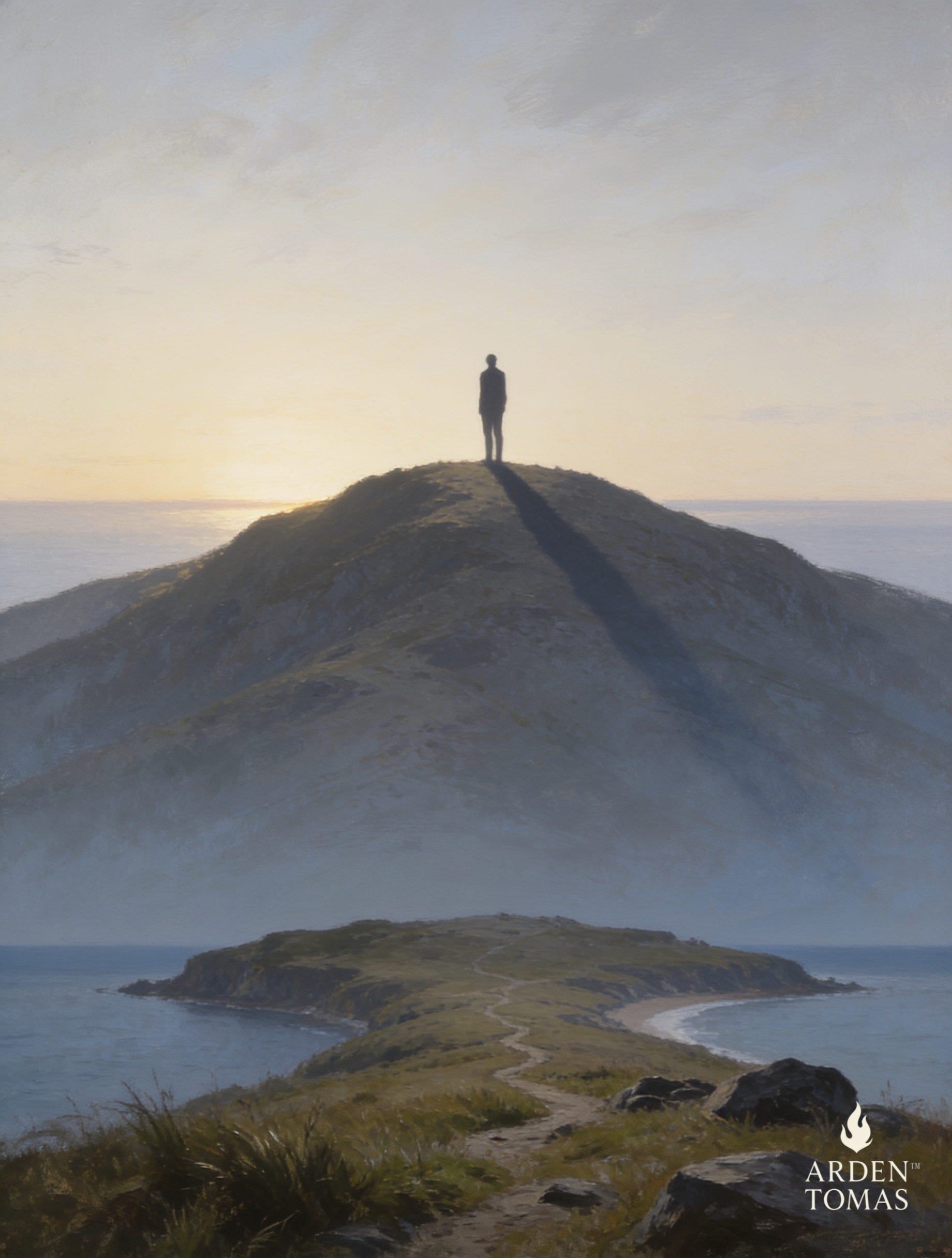
Lucas climbed the hill. The grass was wet, his shoes left tracks. Nathan didn't turn around when he heard the footsteps, but he knew it was Lucas — his body tensed, then relaxed, a barely perceptible wave that revealed he knew this gait, this weight, this person.
Lucas stood beside him. He said nothing. Just stood, and watched what Nathan was watching: the sea, the horizon, the line where sky and water met, and you couldn't tell where one ended and the other began.
They stood there for a long time. The sun rose. The light strengthened. The island was waking — birds, breeze, the distant sound of waves.
"My dad died when I was sixteen," Nathan said. His voice was flat, expressionless, as if reading a distant fact. "Did you know that?"
"No," Lucas said. "You never told me."
"I don't talk about it much." Nathan wasn't looking at Lucas. His gaze was on the horizon. "Heart attack. He was alone in the garage. Mom found him. I was at school. By the time I got home, the paramedics were already there, but there was nothing they could do."
Lucas said nothing. He waited.
"After that, Mom changed. Not right away — slowly. Like something inside her had gone out. The light that used to be in her eyes, it was gone. She wasn't cold — just empty. As if the part of her that felt had died with Dad."
Nathan's voice still didn't shake — but it was slower than usual. He chose each word as if weighing whether to say it or not.
"Then George came. Two years later. At first he was kind. Good to Mom. He laughed. Bought her things. I... I was glad Mom was laughing again. You know? I was a teenager, and I was glad my mother was laughing. I didn't think there was anything wrong with that. I didn't think there was something behind the laughter."

Lucas's hand moved — instinctively, involuntarily — and took Nathan's hand. Nathan's fingers were cold, but this time he didn't pull away. His fingers slowly, very slowly, closed around Lucas's.
"George started... controlling things," Nathan said. "Not with force. He never raised a hand. He didn't need to. His words were his weapons. His comments. His looks. He knew where the cracks were, and he pressed his fingers into them, and kept pulling until the crack split open."
Nathan stopped. The wind blew — stronger than before — and the grass on the hilltop bent, like an army dropping on command.
"I don't know when I realized Mom was part of it," Nathan said. "I don't know when I realized she wasn't a victim — but a tool. That George wasn't using her, but that they were both using me. Or... not me. What's between me and you. Because that's the most vulnerable thing I've ever felt. And they know it."
Lucas's grip tightened on Nathan's hand. He said nothing — he couldn't. His throat had closed, and the words that were there wouldn't come out, because they weren't good enough. Nothing was good enough.
"Lucas," Nathan said, and now he finally looked at Lucas. His eyes weren't empty — they were full. Full of something too big for words: pain, yes, but not only that. Something else. Something that looked like uncertainty. Not about Lucas — but about himself. As if Nathan didn't know if there was anything left inside him that wasn't broken.
"Lucas, what if... what if I can't endure this?"
Lucas's heart stopped — not literally, but it felt like it paused for a moment, and the blood stopped flowing, and the world ceased to exist, only this question, this voice, this gaze.
"You will endure it," Lucas said. His voice was rough, but strong. "Because you're not alone. And because you're stronger than what they did to you. Stronger than what your mother said. Stronger than what George thought."
Nathan didn't answer. He just looked at Lucas, and his eyes — that pair of eyes that Lucas knew, that he loved, that he searched for first every morning — now showed something new. Not trust. Not uncertainty. Something in between. Something that looked like a door half-open, and you couldn't tell if it led in or out.
In the afternoon, Nathan tried to work.
He stood on the hilltop, the blueprint in his hands, Márk beside him. The two new workers hauled stones. The sun burned. Nathan leaned over the blueprint with his pencil and tried to concentrate. The lines, the numbers, the dimensions — this was the language he understood, the order he could create around himself when everything else had collapsed.
Márk asked about the position of the bungalow window. "Nathan, where should the window go? On the east side, so the morning sun comes in, or on the west, so they can watch the sunset?"
Nathan looked at the blueprint. The pencil trembled in his hand — barely, imperceptibly, but it trembled. The lines blurred before his eyes. Not from the sun. Not from exhaustion. But because the blueprint suddenly meant nothing. The lines, the numbers, the dimensions — all of it belonged to another life, a life Nathan had been building, and which now, this summer, on this island, was slowly coming apart.
"Nathan?" Márk's voice was patient, but concerned.
Nathan didn't answer. The pencil slipped from his fingers and fell into the sand. The blueprint trembled in his hands — not from the wind, but because his hands could no longer hold it.
Lucas, who was working on the terrace foundations, looked up. He saw Nathan on the hilltop, the blueprint in his hands, and something in that image — the trembling paper, the motionless body, the expressionless face — was like a scream that made no sound.
Lucas set down the hammer. He climbed the hill. Márk stepped back — he understood he wasn't needed now.
Lucas stood in front of Nathan. Carefully, the way you approach a wounded animal, he took the blueprint from Nathan's hands. The paper landed in his palm — damp with sweat, or something else Lucas didn't want to name. Nathan's hands dropped to his sides, and Lucas saw that his fingers were still trembling — not from cold, but from something deeper, something that came from inside the body and didn't stop on command.
"Come," Lucas said. He didn't ask. He didn't say, "Are you okay?" — because he wasn't okay. He didn't say, "Everything's fine" — because nothing was fine. He just took Nathan's hand and led him away.
Márk watched them go. He said nothing. Just nodded, slowly, and turned back to the stones.
In the tent, Lucas sat Nathan down on the blanket. Nathan sat, his hands in his lap, his eyes staring at nothing. Lucas sat beside him and waited.
For a long time, nothing happened. The sounds of the island seeped through the canvas walls — waves, wind, a bird — but inside the tent there was only breathing, two people's breathing, out of sync.
Then Nathan spoke.
"She taught me to tie my shoes," he said. His voice was quiet, distant, as if recalling a memory he had buried long ago, and now, among the ruins, it had surfaced. "When I was five. Or six. I don't remember exactly. But I remember the motion. She sat down in front of me, took my shoe, and held the lace in her hand. She said: 'Watch, Nathan. First you cross them, then you make a loop, and the loop goes through the hole, and you're done. Try it.'"
Nathan's eyes grew wet — but he didn't cry. The tears were there, on the surface, but they didn't fall. As if something were holding them back.

"And I tried. And I couldn't do it. And I tried again. And I couldn't. And the third time neither. And Mom laughed — not meanly, but... warmly. She said: 'It's okay, sweetheart. We'll try again tomorrow.' And the next day we tried again, and I got it. And Mom clapped, and I was so... so proud of myself."
Nathan stopped. Lucas didn't move. He didn't touch him — he didn't dare. This moment was like crystal — touch it, and it shatters.
"And now," Nathan said, and now his voice trembled — for the first time, truly, not for a fraction of a second but completely, from the beginning of the word to the end —, "now I'm wondering if the woman who taught me to tie my shoes... the woman who laughed and clapped... if she's the same woman who called Frank and gave him money to destroy my marriage. The same hands that tied my shoes handed over the envelope. The same voice that said 'It's okay, sweetheart, we'll try again tomorrow' said 'I didn't know what I was doing.'"
Nathan's face contorted — not from pain, but from the effort of holding back what was coming. But he couldn't hold it back. The tears came — not quietly, not beautifully, but in spasms, suffocating, like something that had been there for a long time and now broke through, like a dam that couldn't hold the pressure.
Lucas said nothing. He didn't say, "It'll be okay." He didn't say, "I'm here." He just wrapped his arms around Nathan and pulled him close, and Nathan buried his face in Lucas's shoulder, and the sobs shook his body — not quietly, not from a distance, but here, now, with full force, the kind of sobbing that isn't relief but devastation.
Lucas held him. Tight. Strong. As if his arms could hold back what had collapsed inside Nathan. They couldn't. But he held on.
That evening, when the island had gone quiet and the workers' boat had long since left, Lucas sat by the fire. Nathan was asleep in the tent — for the first time in three days, he had actually fallen asleep, not just lain awake in the dark. Lucas didn't dare go inside. He didn't want to risk the movement waking him. So he sat outside, by the fire, and watched the flames, and thought.
He wasn't thinking about Nathan's mother. Not George. Not Frank. He was thinking about Nathan. About the Nathan who, three days ago, had still laughed, and worked, and designed the bungalows, and had that life in his eyes, that fire that Lucas had always loved. That Nathan was nowhere now. Instead there was this Nathan — the quiet one, the distant one, the broken one — and Lucas didn't know if the other Nathan would ever come back.
That was the worst part. Not the betrayal. Not the threat. But not knowing how to bring back the person he loved. Not knowing if love was enough. Not knowing if presence was enough. Not knowing if patience was enough. And this not-knowing — this uncertainty, not about the betrayal but about the future — was more deeply terrifying than anything George had ever done.
Lucas stared into the fire. The flames danced, licked the wood, devoured the darkness. But the darkness inside Nathan wasn't the kind of darkness a fire could illuminate. That darkness was inside. Deep. Where light doesn't reach.
Lucas closed his eyes, and for the first time since they'd arrived on the island, he didn't know what tomorrow would bring.

At dawn, Lucas woke in the tent. He didn't remember when he'd come inside — the fire had gone out, the night was cold, and his body had carried him, seeking warmth, into the tent, beside Nathan. Now he lay on his back, his open eyes staring at the canvas, listening to Nathan's breathing.
Nathan was asleep. Deeply, evenly — the kind of sleep that isn't peace but exhaustion. The body had become so tired that it finally gave in, and sleep took him, whether Nathan wanted it or not.
Lucas carefully got up and went outside. The dawn was gray, the air cool. The island was quiet — but it wasn't the silence that lived inside Nathan. This was the island's silence, nature's silence, which knew nothing and cared about nothing, only existed.
Lucas walked down to the shore. The water was smooth, like yesterday, like always. He sat down in the sand and watched the horizon, and tried to think, but thoughts didn't come — only feelings, and the feelings had no names.
Then he heard footsteps in the sand. He didn't turn around — he didn't need to. Nathan came down to the shore and sat beside him. His hair was tangled from sleep, his eyes swollen, but open — and the look in them... Lucas couldn't read it. Not empty, not distant, not pleading. Something else. Something Lucas had never seen before.
Nathan said nothing. Lucas said nothing. They just sat on the shore, at the water's edge, and watched the dawn slowly brighten, and the island slowly wake, and the future slowly arrive, and there was no telling what it would bring.
Nathan's hand slowly slid through the sand and stopped beside Lucas's hand. He didn't take it. It was just there. Two hands in the sand, side by side, not touching, but not apart. Like two islands drifting closer, but not yet meeting.

The sun rose. The light swept across the water, the sand, the two hands. Nathan closed his eyes, and on his face — which for three days had been a mask, expressionless and distant — something now appeared. Not a smile. Not tears. Something older than either: a weariness that belonged not to the body but to the soul, and which for one moment looked like surrender. Not toward Lucas. Not toward the world. But toward his own pain — as if Nathan had finally stopped fighting it and let it pass through him, because he understood that pain wasn't an enemy but a part of who he was, and it couldn't be driven out, only endured.
Lucas watched, and didn't know if this was good or bad. Didn't know if surrender was the beginning of healing or the beginning of giving up. Didn't know if Nathan was coming closer to him or drifting away for good, into his own silence, his own darkness, where Lucas couldn't follow.
Nathan opened his eyes. He looked at Lucas. That gaze — which now was like a door half-open, and you couldn't tell which way it swung — settled on Lucas's.
"Lucas," Nathan said. His voice was quiet, hoarse, and there was something in it that hadn't been there before — not strength, not hope, but something that might have been the beginning of truth, or maybe the end of it.
"Yeah," Lucas said.
Nathan swallowed. His lips moved, as if he were about to say something — something big, something important, something that would change everything or confirm everything — but the word didn't come. The word was there, in his mouth, on the tip of his tongue, but it wouldn't come out, and Nathan didn't force it.
Then Nathan turned away and looked out at the sea. His hand in the sand shifted — an inch, maybe two — toward Lucas's hand. But it didn't reach it.
The sun climbed. The island woke. The waves came and went, came and went, like always, like always, like always.
And the two hands in the sand didn't touch.
End of Chapter XXVIII
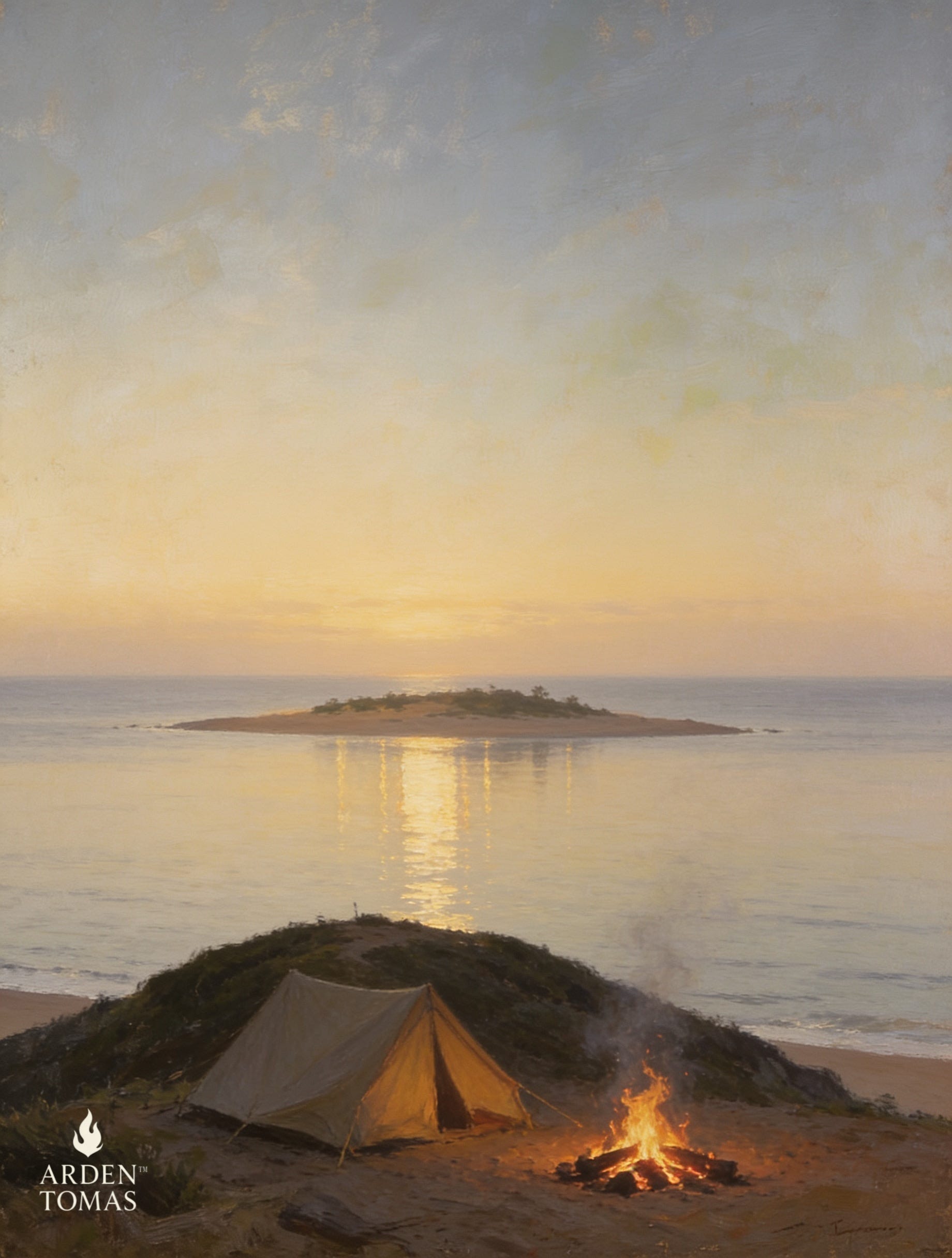

Its bleak, but I rhink in a way the pain has to eventually give way to a decision Nathan has taken, even if he won't admit it! For the first time, the battle is with himsel, uncertainty will heavy on the future, not with Lucas but himseld...