

THE WORDWRIGHT – CHAPTER I.
THE BOX 🔞

🔞| Explicit sexual content | Mature audiences only⚠️‼️
October 27, 1978, Wednesday.
The rain didn't fall. It saturated. It was a drizzle that didn't drip from the eaves but seeped into the old oak beams of the manor, and from there trickled down into the walls in the form of a constant, damp sigh. Leo stood at the library window, pressing his palm against the cold glass. The pulse of his veins beneath his skin was in sync with the rhythm of the rain tapping on the roof. The park outside was a gray watercolor – the bushes blurred, the earth showed dark purple stains, the gate, that rusty, tall gate, disappeared into the fog. Only the embers in the fireplace gave some warmth, but even that felt as distant as a picture seen in another life.
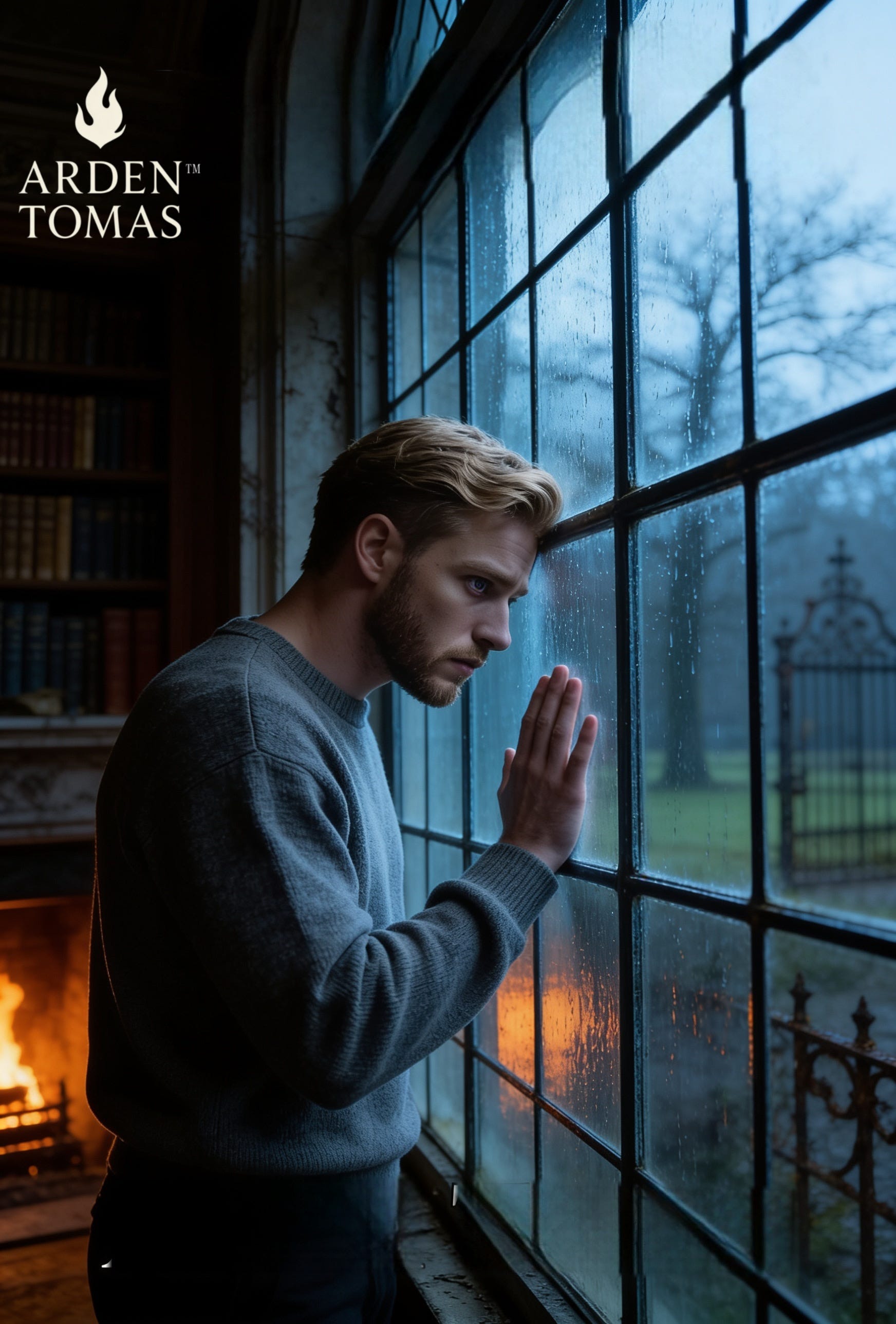
The house creaked. Not from the wind. Under its own weight. Deep, painful cracks rose from the beams, as if some giant animal were stretching in its sleep. Then, exactly at half past six, as Leo was bending to add another log to the fire, a different sound broke through: a dull, wet thump, followed by a long, sorrowful slither, as if a large body were sliding to the ground.
Leo froze. The wood in his hand stopped in mid-air. This wasn't the usual noise. Something had collapsed.
A minute of complete silence followed. Only the roar of the rain and his own heartbeat in his ears. Then familiar footsteps in the hallway – heavy, but regular, always two steps, a pause, another two steps. Benedek. The door opened quietly, and the butler appeared on the threshold. A man around sixty, balding, with a serious face. His gray apron was clean, but the smell of kitchen soap still lingered between his fingers. He wasn't carrying tea. He held a large, black flashlight in his hand, his fingers gripping the handle tightly.
"Forgive me, sir," came Benedek's deep, calm voice, which always sounded as if it came from another, more stable world. "The north wall. In the cellar. The plaster I mentioned. It fell."
Leo slowly put down the wood. His hand trembled slightly. Not from the cold. "Is the damage bad?"
"The damage… I don't know." Benedek hesitated unusually. His eyes, which usually revealed nothing, were fixed on the floor. "The hole… behind it, the wall isn't solid. It's as if… there was some kind of opening there once. Bricked up. But not properly."
The word "not properly" caught Leo's breath. Everything in his world here was proper: breakfast, walks, solitude, pain. "Not proper" promised something else. Something that might break through the thick, glass wall surrounding him.
"I'll go down," Leo said, and his voice was hoarser than he wished.
"I wouldn't recommend it, sir. It's cold, and the structure…"
"I'll go down," Leo repeated, and was already heading for the door. Benedek started to follow, but Leo turned. "Alone, Benedek. Please."
The butler nodded, a single motion that expressed all his concern and, at the same time, his respect. He handed over the flashlight. "Mind the steps. They might be damp."
The cellar air had always been special. Not just the sharp, sour smell of mold, but something sweet too – the scent of rotting wood and dry leaves that wafted from the old shelves, and the deep, earthy stench of damp stone. But tonight something new mixed in: the smell of fresh, yellowish clay and crumbling plaster dust. The flashlight's piercing beam stuck to the wall. And there it was.
Not a small crack. In the middle of the north wall gaped a dark, damp wound. As if the house's body had been mangled. A whole hand-thick layer of plaster had fallen away, and deep within, behind the red bricks… it wasn't solid wall. A cavity. A dark, irregular opening that had once, perhaps centuries ago, been hastily, crudely bricked up. Between the brick fragments, a deep blackness broke through, so dense the light barely penetrated.
Leo stepped closer. His breath rose in clouds in the cold air. He reached out his hand and touched the damp brick. Ice cold. Under his fingers, a piece shifted, loosely, as if it had only been waiting for someone to touch it. This wasn't a discovery he'd sought. It was a collapse that had come on its own. The house, like him, was slowly falling apart, and from the cracks seeped an ancient, forgotten secret.
And Leo, who had spent so many nights staring into the dark of his own solitude, now stared into another darkness. And in that moment, in the dusty, cold air of the cellar, something ancient and merciless surged in him – not for sex, not for a body. But for something, anything, to step out of that dark and look at him. Even a monster. Even a ghost. Even just a shadow. Something that would confirm he was still alive, and that his pain was real.
His hand was still on the brick when the flashlight beam trembled, and for a moment it seemed something moved in the depths of the dark cavity. Just a shadow. Or his imagination.
But Leo's heart gave a strong, painful throb in his chest.
After the discovery, Leo didn't go back to the library. The cellar dust and the cold cling of the damp stone on his skin felt like a second skin – a contaminated, ancient skin. He went up the stairs, still clutching the flashlight as if afraid the light would abandon him too. He crossed the hallway to the bathroom – a large, white-tiled room dominated by a huge cast-iron tub and a separate, old shower stall with a yellowed plastic curtain.
He turned on the light. The cold, white light mercilessly exposed everything. In the mirror, a stranger looked back at him – pale, dark circles under his eyes, his mouth tightly shut. The cellar dust left gray specks on his forehead and chin. He tried to wipe them off with his hand, but only smeared them.
He turned on the taps. First only cold came, sharp, needle-like stings on his skin. Then the hot water, which instantly burned away the cold and raised a cloud of steam. Leo undressed. His clothes – the gray sweater, the jeans – lay curled on the floor like a shed skin. He stepped under the shower and pulled the curtain shut. The noise completely swallowed the world: the water rushing over his head, hitting the tiles, the deep gurgle of the drain.
His hand first only sought his body. He rubbed his shoulders, where tension had hardened into knots. Then it slid lower. Over his chest, where his heart was still beating fast. Over his stomach, which tightened from the cold and the excitement. And finally down between his legs, where desire already stood as a hard, painfully awkward mass.
He closed his eyes. The hot water ran down his face, into the corners of his mouth. His hand moved on himself, first slowly, pleadingly, then more and more decisively. But it wasn't enough. The body wasn't enough. Fantasy had to take over.
And the fantasy didn't think of an unknown man. Not of a vague shape. The image that surfaced behind his closed eyelids was agonizingly precise. Alexander.

Not as he had seen him in the mirror – but as he had imagined him when he wrote him. In his novel. Alexander stood outside the shower curtain, in the steam, just a dark silhouette. Then the curtain slid aside. He wore no clothes. His body was exactly as Leo had described: broad shoulders, narrow waist, muscular thighs. But the details… God, the details. The hair on his chest stood in dark, wet streaks. The muscles of his stomach were taut. And between his thighs… it stood, hard, curved, the head purplishly swollen, a drop of pre-cum glistening on it.
The fantasy Alexander didn't speak. He only watched. His eyes – they were like Leo's, but deeper, darker, filled with a hunger Leo had never dared admit to himself. His gaze traveled over Leo's body, over the water droplets running on his skin, where his hand was working. Then Alexander stepped closer. His hand – not Leo's hand – reached out from the steamy air and touched Leo's hand, which was on his own cock. At the cold, alien touch, Leo moaned. The fantasy hand was stronger, rougher. It took over. Its motions weren't gentle. They were greedy. Relentless. As if it weren't working for pleasure, but to extract something – a confession, a surrender.
"You wrote me," whispered the fantasy Alexander's voice, deep and husky, directly into Leo's ear, amid the noise of water and breathing. "Every detail. How I'd like to hold you. How fast I want to take you. Now give it to me. Give me your desire. Give me your fear."
Leo's head fell back, the back of his skull hitting the cold tile. Pain and pleasure intertwined. His hand – or Alexander's hand – moved faster and faster. The vision grew sharper. He saw Alexander's mouth as it tightened, the whiteness of his teeth. He saw the muscles of his shoulders tensing. And he felt – not imagined, but felt – the weight of another body's pressure against his thigh, against his stomach. Someone else's breath on his neck. Someone else's will, guiding his own.
The shower water poured hot over him, but his skin goosebumped. A cold shiver ran down his spine. Deep down, in the pit of his stomach, the tension built, like a huge, black sphere sucking in every thought, every fear, every memory. The cellar's dark, the smell of old stone, the word "not proper" – all merged in this moment, in this physical, self-destructive need.
"Now," whispered Alexander's voice, and it wasn't even a voice anymore, just a thought that sprang from Leo's own brain. "Now give it all. Your loneliness. Your wounds. What you left behind in that hole."
And Leo… gave it. With a long, panting, almost sobbing groan that disrupted the steamy air. The wave that ran through his body was so strong his knees buckled, and he had to brace himself with his hand against the wet tile to keep from collapsing. He closed his eyes, and in the dark he saw only Alexander's face – his own face, but distorted, triumphant, and infinitely sad.
Then… nothing. Just the rushing water. The empty fatigue of his body. His hand, which slowly slid down, trembling. The fantasy evaporated, like steam from the mirror.
Leo opened his eyes. He was alone in the shower stall. The curtain was untouched. The tiles were cold. The water on his body was only lukewarm now. Deep down, in the pit of his stomach, instead of post-orgasm emptiness, a new, deeper, bleaker emptiness settled. As if he hadn't just poured himself out, but something else had leaked out of him. Something the cellar's dark had caught.
He turned off the water. In the sudden silence, his ears rang. He toweled off mechanically, didn't look in the mirror. Then he put on his pajamas – the fabric was cold against his still-damp skin – and went back to the library. The fireplace fire had died. It was still raining outside.
He sat down at the desk. The Pelikan fountain pen still lay where he'd left it. He picked it up. It was heavy and cold. His hand was still trembling.
And then, in the silence, a thought flashed through his mind, so sharp and clear it was as if someone else had said it:
If you want him so badly that you write him… why not try again? Now that you know what his touch is like? Now that your wounds are on the paper too?
Leo looked up. In the dark window, he saw only his own faint reflection. But for a moment, it seemed that behind him, in the room, a second shadow moved. A movement that was exactly like what he'd felt in the shower.
His hand hovered over the pen. A blank sheet lay before him.
And he knew that if he wrote Alexander's name now… something else would happen. Something from which there was no turning back.
October 28, 1978, Thursday morning.
The morning was cold and quiet. The rain had stopped, but from every pore of the manor rose the cold breath of dampness. Leo had barely slept. His body still held the memory of that shower-time fantasy, agonizingly precise – the pressure of Alexander's hand on his own, his voice in his ear. This was no longer desire. It was a command. The cellar waited with that dark hole like a gaping mouth.
Benedek wanted to serve breakfast, but Leo waved him off. "I'll be busy with the cellar. Don't disturb me."
"But, sir, the structure…"
"Alone, Benedek. Please."
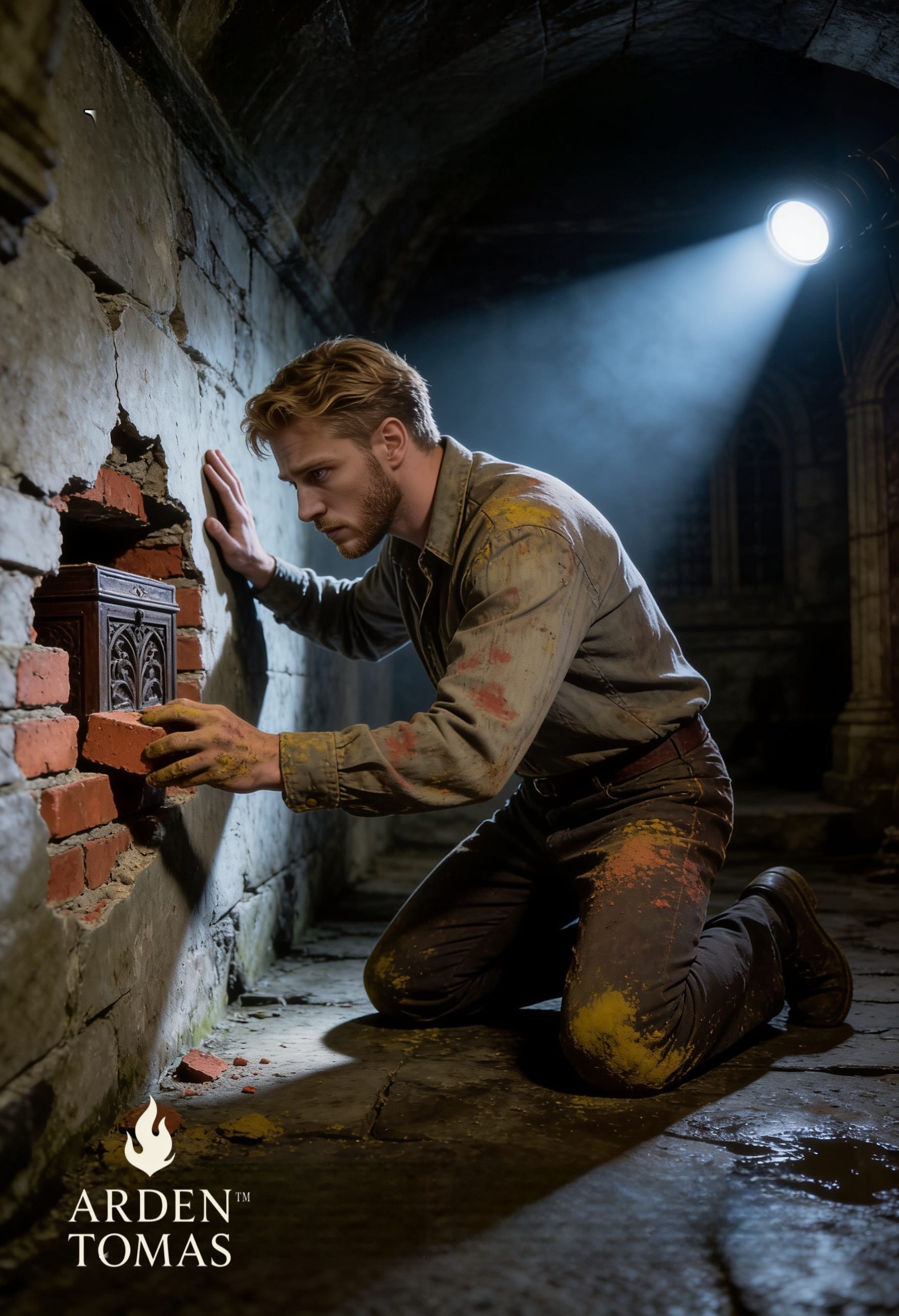
The cellar air was even sharper with the smell of mold, as if the dampness had penetrated deeper overnight. The flashlight beam now illuminated not just the wound, but the whole damaged area. Leo knelt on the cold, damp stone floor. With his hands, first carefully, then more decisively, he began to remove the loose bricks and plaster debris. His fingers were soon soiled with red dust and yellow clay. Every movement was painful in his shoulder, but this pain was welcome. Physical. Real.
Then his fingers felt not stone, but wood. A smooth, cold wooden surface. He stopped. His breath quickened. He pulled out more bricks, carefully, fearing something might collapse. With a piece of canvas Benedek had left, he wiped away the dust.
Before him was a box. Not large. About the size of a book, but thicker. Dark oak, carved. On its lid were intricate, interlocking circles and wave patterns carved into it, like nothing he'd ever seen – not geometric patterns, but rather the signs of some ancient, fluid script. Its lock wasn't a lock. It had three rotatable, bronze dials, each with strange, dot-like symbols. A code.
Beside the box, on the ground, lay a book. Its cover was thick, black leather, the edges worn. Its title in gold letters was almost completely faded, but still legible: THE BOOK OF DARKNESS. Leo picked it up. It was so light, as if the pages inside were empty. He opened it. Inside were yellowed parchment pages, written in bristly, black letters – in Gothic script. Diagrams, constellations, and texts he immediately knew weren't in Hungarian, yet somehow he understood their meaning. One sentence jumped out, as if underlined: "He who pours the dark of the soul into the light of words, his pen is the key. But I warn you: what you write comes back. Not as a shadow. As a mirror."
His heart beat violently. His hand trembled. Clutching the box and the book to his chest as if he were stealing them, he rushed up the stairs, back to the library. He didn't run into Benedek.
He placed the two objects on the desk. The morning light now shone in more strongly, and the carvings on the box cast deep shadows. The Pelikan pen lay at the edge of the desk, now seeming an indifferent, modern tool. The real power was here before him, in this box.
He sat over the book for hours. He studied the symbols. The diagrams pointed to a recurring motif: a hand holding a pen, from which waves emanated, and those waves flowed into another, mirror-image figure. The text contained cryptic references to dates, birth signs. And then he understood. The three dials. It wasn't numbers to set. His own birth date. And not letters. The initials of his own name.
With trembling fingers, he turned the dials. 1950. March. 12. Then: L. T. M. – Leo Tamás Mózes. (His middle name, which he never used, now perhaps for the first time in his life became important.)
A deep, metallic CLICK sounded, so utterly loud in the silence that Leo jerked back. The lid of the box popped open slightly.
Slowly, he lifted it.
Inside, on purple velvet, lay the pen. It wasn't silver, wasn't gold. It was made of a dark, almost black material, perhaps ebony or something even denser. Its tip wasn't a metal point. It was a gleaming, black stone, like obsidian, sharpened to a point. The pen's shaft was intricately wrapped with fine silver wires, forming a pattern like that on the box's lid. Beside the pen was a small crystal inkwell, filled with a dark, violet fluid.
Leo picked up the pen. It was cold. So cold he almost dropped it. But then a strange warmth began to flow from it into his palm, up his arm, as if it were feeding on his own blood. The pen was weightless and heavy at the same time.
He pushed the Pelikan aside. He took out his best writing paper – the silky, cream-white sheets. He opened the crystal inkwell. Its smell was sharp, metallic, a little sweet, like blood when you lick it with your tongue.
He dipped the pen into the ink. The black stone drank the fluid and began to emit a faint, violet glow.
His hand hovered over the paper. His heart beat as if it would tear free. The fantasy image of Alexander floated before him again. But now it wasn't just the imagination of desire. Now it was a recipe. A blueprint. The perfect, distorted mirror image of his own being.
The tip of the pen touched the paper.
And Leo began to write. Not his story. Not the plot. Him. Alexander's name. Then his description. Every detail he had seen in the shower, and which had since been burned into his soul. But he didn't stop at the exterior. The pen, as if it had its own will, carried on. He wrote his secrets, which he had never confessed: his fear of abandonment, his desire for total control, the dark thought of what it would be like to never have to fear again. If he were the stronger one. If he were the one who watches, who desires, who takes.
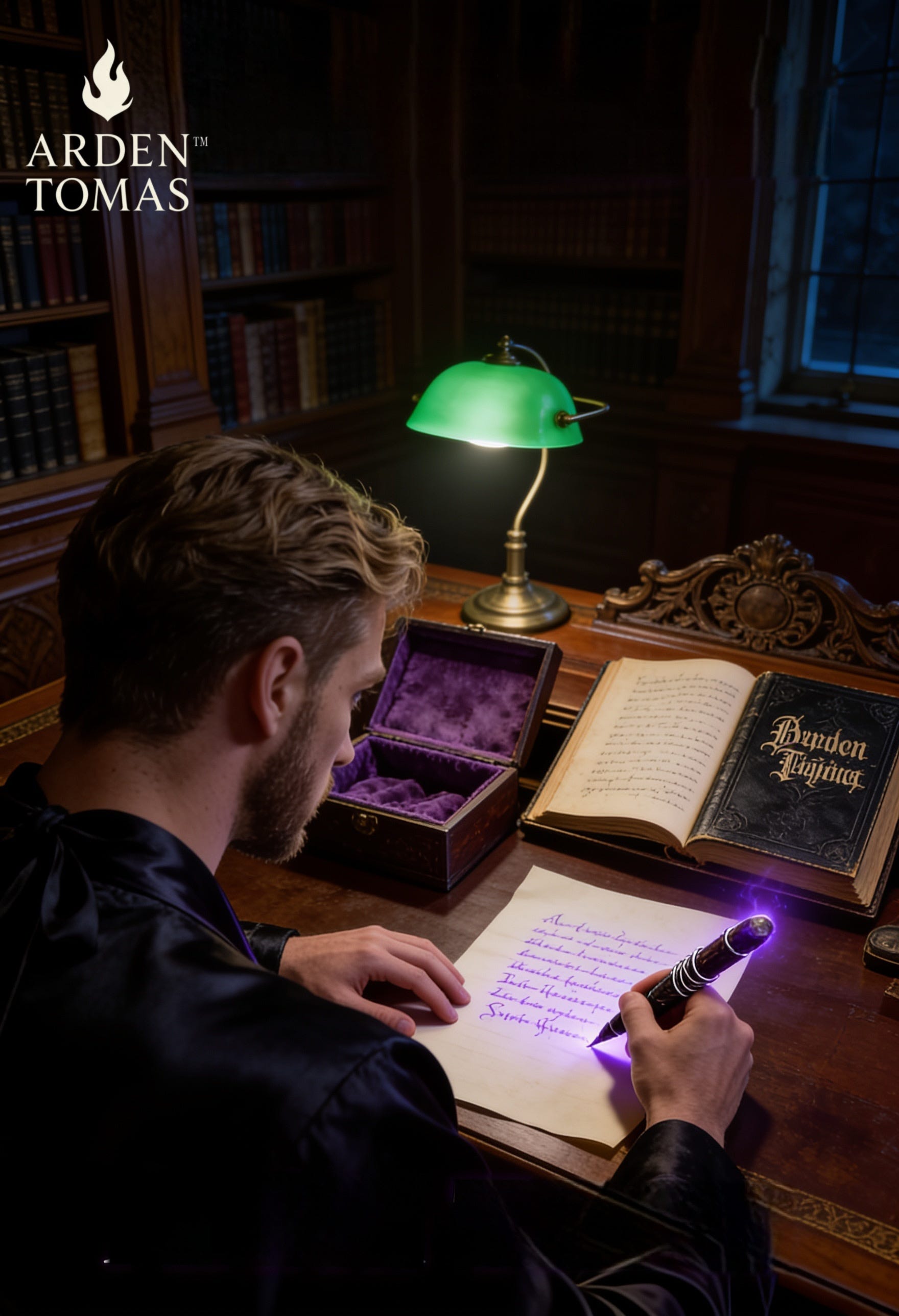
The words flowed, the black stone tip scratching softly on the paper. The violet ink seemed almost alive as it dried, as if it were breathing.
And when he wrote the last sentence – "And Alexander knows that Leo is his forever" – the pen suddenly stopped. The cold that had radiated from it vanished. In its place remained a familiar, bodily warmth. As if he were holding his own hand.
Leo looked up. The room was the same. The morning light. The fireplace ashes. But the air was thicker. Full of anticipation. Like a long, deep breath taken by someone behind him.
The paper he had filled was no longer just paper. It was a door. A door he had now opened.
And Leo knew that as soon as he lowered his head, or moved from the chair, something would happen. Alexander wouldn't appear tomorrow.
Alexander was already here. In some corner of the room. Or perhaps already on the threshold. Waiting for Leo to look up and finally face his own, perfectly written self.

I absolutely love this, very different from your other stories but what a briliant start!! 🤌❤️😍
«Leo Tamás Mózes. (His middle name, which he never used, now perhaps for the first time in his life became important.)» 😍