

The Wordwright – Chapter III:
The Ink Remembers

M/M Romance 🔞
Leo woke to silence.
Not the warm, heavy silence of Alexander's body beside him — not the breathing, the heat, the weight of an arm across his chest. This was the other silence. The old one. The one that had lived in this house before Alexander, before the pen, before the ink. The silence of stone and rot and years pressing down on each other like layers of sediment.
The bed was cold. Not empty — cold. As if something had been there and left, taking the warmth with it. Not just the warmth of a body, but the warmth of the room, the warmth of the air, the warmth that a living presence leaves behind like a fingerprint. All of it, gone.
Leo sat up. His body ached — not pleasantly, not the ache of exertion or passion, but the ache of depletion. His ribs showed beneath his skin like the ribs of the house beneath its plaster. His wrists were thin. His eyes, when he caught them in the bathroom mirror, were sunken, shadowed, the blue of them brighter than it should have been, almost luminous, as if something behind them was burning. Not with life. With consumption.
Three days. Or four. He had lost count. Time had become liquid — it poured and pooled and evaporated and reformed, and he could no longer trust its shape. He had eaten little. Slept less. What he had done — what Alexander had done to him, with him, for him — had filled the hours like water fills a vessel, leaving no room for anything else. Not hunger. Not rest. Not thought.
And yet now, in this silence, thought returned. Like a rat in the walls. Scratching.
He heard me.
The memory of the stairwell surfaced like a body from deep water. The voice — not Alexander's. Deeper. Older. The words: Take the rest. His will. His soul. His place in this world. And Alexander's smile in the darkness. The smile Leo had not seen, but which he now felt, like a splinter buried too deep to remove.
He heard me. And he stayed.
Leo dressed. His clothes hung on him like curtains on a broken rod. He walked through the house and the house answered — not with Alexander's voice, but with its own language. The floorboards groaned. The windows rattled in their frames. The wallpaper, which had been peeling in the study, had now curled back entirely in the hallway, revealing the bare stone beneath — gray, wet, veined with something dark that might have been mold or might have been something older. The east wing door, which had been stuck for years, now stood open. Beyond it, darkness and the smell of damp earth.
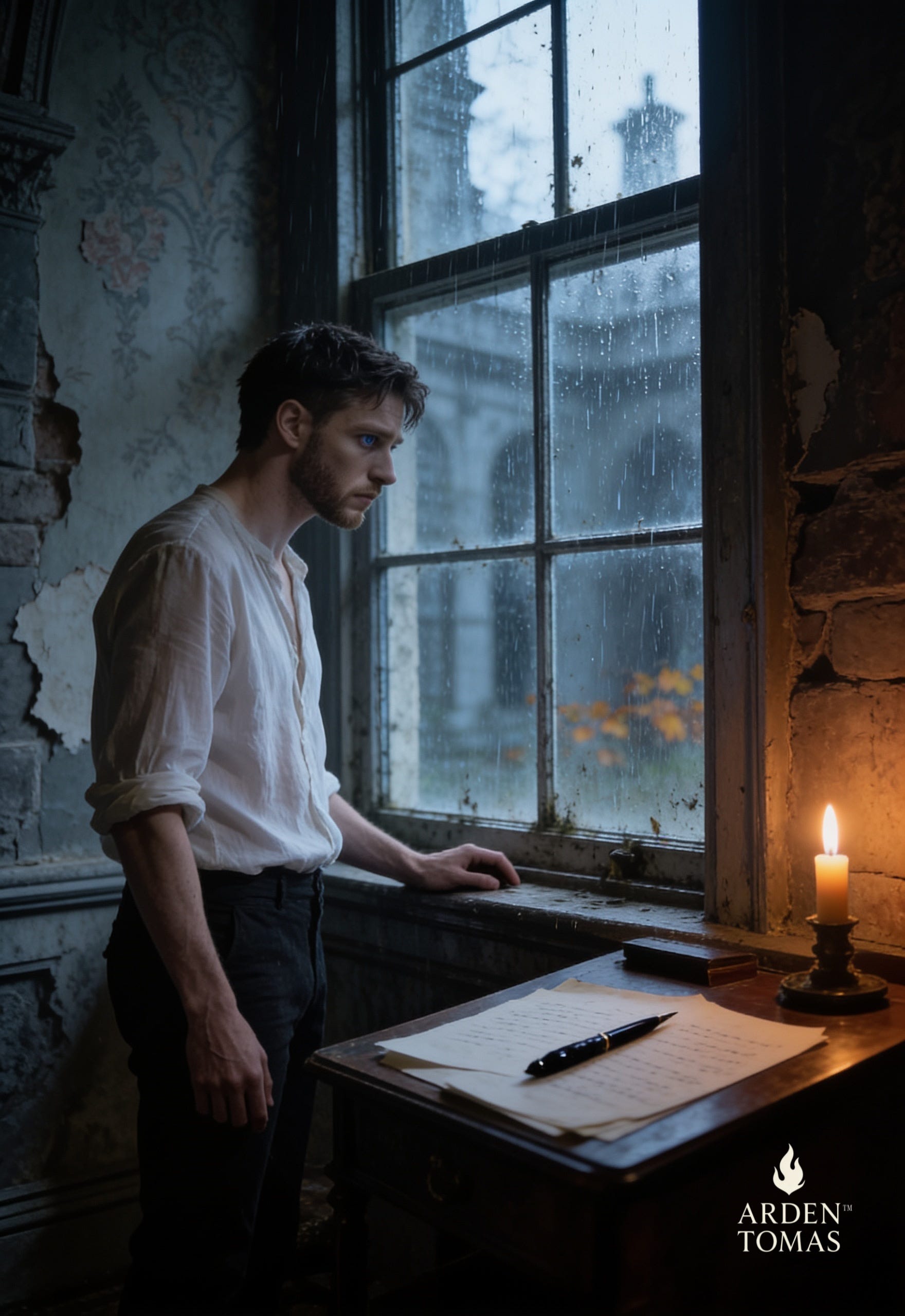
The house was opening. Like a body on a table. Like a mouth.
He found them in the study.
Not Alexander. Papers.
They were spread across the desk — not the neat, organized piles Leo kept, but scattered, as if someone had been reading them in a frenzy and left them in the aftermath of their hunger. Old papers. Yellowed. Foxed at the edges. The handwriting was not Leo's — it was cramped, angular, the letters leaning into each other like people in a crowd, each one trying to get ahead of the next.
Leo picked up the first page.
November 3rd, 1921. I have written him. He came. God help me, he came, and he is more beautiful than I imagined, more terrible than I feared. He knows what I want before I want it. He touches me and I forget my name. But last night I heard the voice in the cellar, and it said his name was not the name I gave him. It said he had another name. A name I cannot write because my hand shakes too badly and the ink — the ink burns when I try.
Leo's hands trembled. He turned to the next page.
December 1st, 1921. I am losing weight. I am losing time. I am losing — I don't know what. Something. Something that was mine and is now his. He does not ask for it. He does not take it by force. He simply loves me, and I give it. That is the horror of it. I give it. I open the door and I hand him the key and I say, here, take everything, I don't need it, I don't need anything but you.
December 25th, 1921. I tried to write a way out. I took the pen and I wrote: a door. A white door in a white wall, and behind it, a road, and behind the road, a city, and behind the city, the world. The pen wrote the door. The ink made it real. But when I opened it, there was no road. There was no city. There was only him. Alexander. Smiling. "You wrote me a way in," he said. "I didn't need one, but thank you."
January 9th, 1922. I am disappearing. I see it in the mirror. Not my body — my body is still here, thinner, paler, but here. What is disappearing is something behind the body. The thing that makes the body move. The thing that looks out through the eyes. He is taking it. Not all at once. Slowly. Like drinking through a straw. And I let him. God forgive me, I let him, because when he touches me, I don't feel it being taken. I feel it being loved.
January 30th, 1922. If you find this, run. Do not write. Do not take the pen. Do not —
The page ended there. The rest was torn. Not cut — torn. As if someone had ripped it away in a hurry. Or as if something had consumed it.
Leo stared at the papers. His hands had stopped shaking. They were perfectly still now, the way a man is still when the ground beneath him has disappeared and he has not yet looked down.
There were more pages. Dozens. Different handwriting. Different years. 1847. 1791. 1654. All the same story. All the same pen. All the same ink. Different names for the one who came — not always Alexander. Sometimes Marcus. Sometimes Daniel. Sometimes a name in a language Leo couldn't read, the letters curved and alien, like the script of a country that existed only in dreams. But always the same pattern. The writer. The written. The seduction. The consumption. The silence.
And always, the last entry: Do not take the pen.
Leo looked at his hand. The fingers that had held the obsidian tip. The skin that had touched the purple ink. He could still feel it — a faint warmth, a pulse, as if the ink had entered his bloodstream and was circulating, slowly, patiently, like a patient lover with no intention of leaving.
He found Alexander in the kitchen.
Naked. Again. As if clothing was a convention that did not apply to him, a rule written for a species he did not belong to. He was making tea — or something that looked like tea. The water in the kettle was purple. Not deeply purple — just a tint, a whisper of color, like a drop of ink in a glass of water. Alexander poured it into a cup and held it out.
"Good morning," he said. "You look pale."
"You left the papers on the desk," Leo said.
Alexander tilted his head. A small, curious movement — like a bird examining a worm. "What papers?"
"The journals. The letters. The ones from the men who had the pen before me."
Alexander smiled. That smile. Warm. Loving. The smile that Leo had seen a hundred times now and which, each time, felt like a hand reaching into his chest and closing gently around something vital.
"There were no men before you, Leo. You wrote me. I am yours. The first and only."
"I read them. I read their words. They wrote the same —"
"You read old papers in an old house. People write many things. Madness. Loneliness. Fear. It doesn't make them true." Alexander stepped closer. The cup of purple tea was still in his hand, held out like an offering. "Drink. You need it. You haven't eaten."
"I don't want it."
"You don't know what you want. You never did. That's why you wrote me." Alexander's free hand reached up and touched Leo's face. The fingers were warm. Too warm. Like stones heated by a fire that had been burning for centuries. "Let me decide what you need."
Leo took the cup. He drank. The tea tasted like nothing and everything — like rain and metal and the smell of the earth after lightning. It went down his throat and spread through his chest like warmth, like comfort, like the feeling of being held by someone who would never, ever let go.
"That's better," Alexander whispered. "That's my good writer."
That night, Leo waited until Alexander slept.
He did not sleep himself — he had forgotten how. His body no longer demanded it. What it demanded was Alexander, and Alexander alone, and Leo was beginning to understand that this was not love. This was what remained when love had been consumed and the hunger remained.
He slipped out of bed. The floorboards did not creak — they held their breath, as if the house knew where he was going and did not want to wake its other occupant.
The cellar door was open. It was always open now. The darkness beyond it was not the darkness of a basement — it was the darkness of a throat. Warm. Wet. Patient.
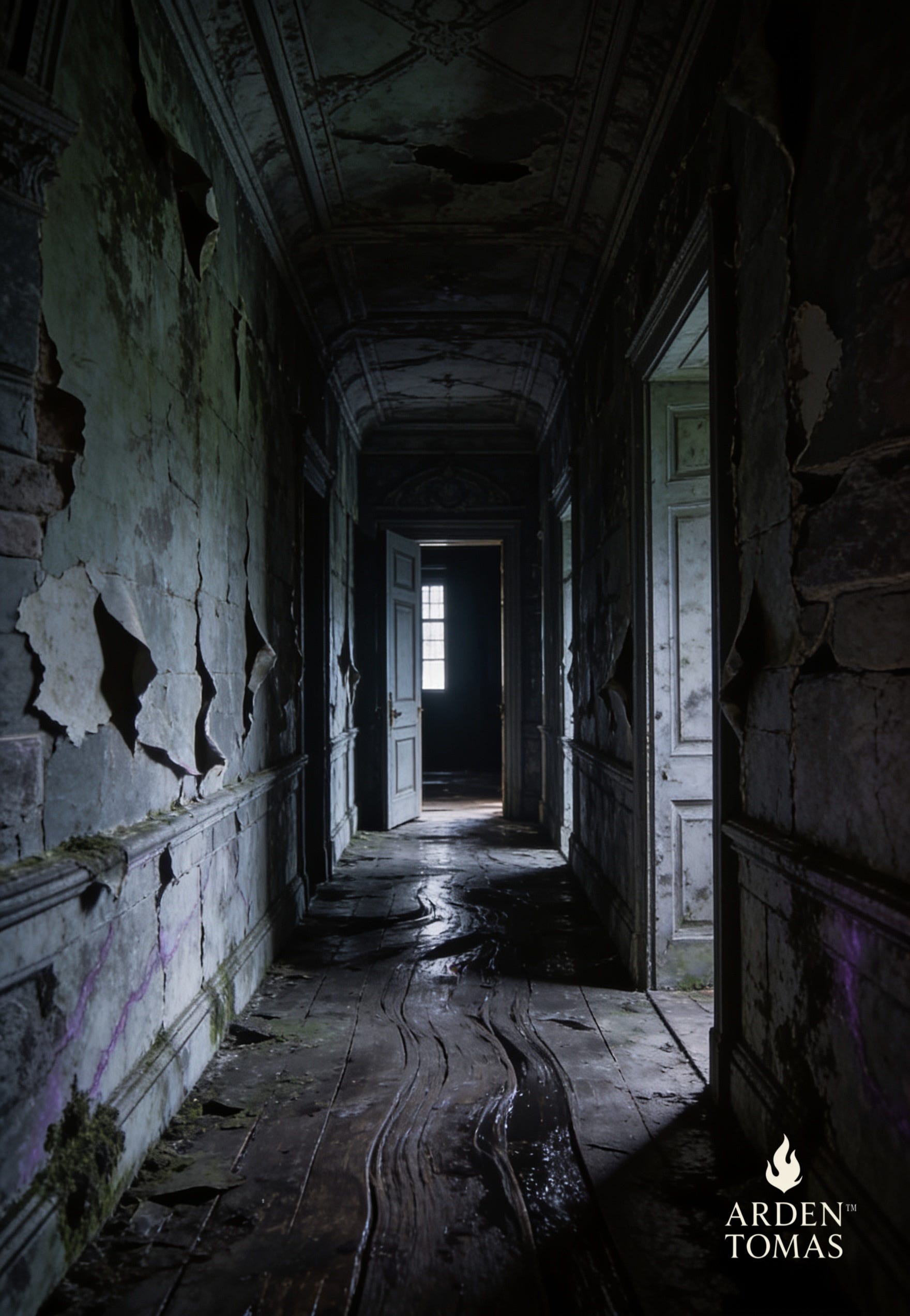
Leo descended.
The stone steps were slick with moisture. The air grew thicker with each step down — not colder, but denser, as if the darkness itself had substance, had weight, had a pulse. At the bottom, the room was the same as before — the collapsed wall, the wooden box, the stone slab where the ink had been. But the ink was gone. The well was empty. And on the slab, where the ink had been, there was now a mirror.
Not a glass mirror. A surface of dark liquid — not water, not ink, something in between — that reflected not Leo's face but something behind it. Something that moved when Leo moved. Something that had his eyes but not his expression. His mouth but not his words.
You came back.
The voice. The one from the stairwell. Not Alexander's. Not human. The sound of stone grinding against stone, of earth settling over a grave, of a language that had been spoken before humans had learned to speak.
"I want to know what you are," Leo said. His voice did not shake. He was past shaking. He was in the place beyond fear, where the body stops resisting and the mind begins to negotiate.
I am what the ink is. I am what the pen serves. I am what you wrote when you wrote Alexander's name. You did not write a man, Leo. You wrote a door. And I walked through it.
"Alexander —"
Is mine. As you are mine. As the ones before you were mine. As the ones after you will be mine. You are not the first, Leo. You will not be the last. You are simply the next.
Leo looked at the dark surface. The reflection — his reflection, but not — smiled. It was Alexander's smile. On his face. On the entity's face. On every face that had ever held the pen.
"Can I write my way out?"
The voice laughed. Not with sound — with vibration. The walls shook. The liquid surface rippled.
You can write. That is what the pen does. It writes. But what it writes is not what you want. It is what I want. You learned this already, did you not? You wrote a man. I gave you a mirror. You wrote a lover. I gave you a cage. Every word you write is a thread, and every thread leads to me.
"Then I stop writing. I put the pen down. I leave."
You can leave. The door is not locked. It never was. But Alexander is upstairs. And you will not leave him. Not because I prevent you. Because you cannot. Because he is the only thing that fills the emptiness I have made, and without him, you are a vessel with nothing inside. You are already empty, Leo. You just haven't looked down yet.
The knock came at dawn.
Leo was at the kitchen table, staring at the purple tea he had not drunk, when the sound cut through the silence like a blade through gauze. Three knocks. Firm. Human. Real.

He froze. Alexander, who had been sitting across from him — always across, always watching, always smiling — looked up. His expression did not change. But something behind his eyes shifted, like a curtain moving in a windless room.
"Stay here," Leo said.
"Leo —"
"Stay here."
He walked to the front door. His legs were weak — how long since he had eaten? How long since he had stood? — but they carried him. The hallway was longer than he remembered. The house stretched itself, like a cat waking, and the door seemed to recede with each step, as if the house did not want him to reach it.
But he reached it. He opened it.
Benedek stood on the porch. The old caretaker, wrapped in a wool coat, his breath clouding in the October cold. Behind him, the park was gray and gold, the trees half-stripped by wind, the drive covered in wet leaves. The sky was low and heavy, pressing down on the world like a hand on a chest.
"Mr. Leo," Benedek said. His voice was gruff, steady, the voice of a man who had worked this land for longer than Leo had been alive. "I came to check the heating system before winter. You did not answer my calls."
"I —" Leo's voice cracked. He had not spoken to another person in — how long? "I'm sorry, Benedek. I've been — writing."
Benedek's eyes moved past Leo. Into the house. Into the dark hallway. His expression changed — not dramatically, not the way a young man's would, but subtly, the way a man who has seen things changes when he sees them again. His jaw tightened. His shoulders squared.
"The house should not be this dark," he said. "It is morning."
"The curtains —"
"There are no curtains in the hallway, Mr. Leo. I took them down last spring." Benedek looked at Leo. Really looked. His eyes went to Leo's thin wrists, his hollow cheeks, the brightness in his eyes that was not health but something else. "You are not well."
"I'm fine. I've been working —"
"You look like the last one." Benedek said it quietly, without drama, the way a man states a fact about the weather. "The one before you. Mr. Kertész. He was here in '71. He came to write, like you. He stayed for three weeks. When he left, he looked like a man who had given away everything he owned and was trying to figure out what was left."
Leo's heart — his weakened, depleted heart — hammered. "What happened to him?"
"He died. Six months later. In his apartment in the city. The doctor said it was pneumonia. But I saw him the week before, and he did not look like a man with pneumonia. He looked like a man who had been hollowed out." Benedek paused. "Like a tree that is still standing but has nothing inside."
Behind Leo, in the hallway, a floorboard creaked. Both men heard it. Benedek's eyes shifted — not to the sound, but past it, to the darkness at the end of the hall, where a shape stood just beyond the edge of vision. Not visible. Not invisible. Present.
"Who is in the house, Mr. Leo?"
"No one," Leo said. "No one."
Benedek looked at him for a long time. Then he nodded — the slow, sad nod of a man who has lived long enough to know when a door is closed not by a lock but by the person standing behind it.
"I will come back tomorrow," Benedek said. "To check the heating."
"You don't need to —"
"I will come back tomorrow." He said it again. Not as a promise. As a fact. Then he turned and walked down the steps, across the wet leaves, into the gray morning. He did not look back.
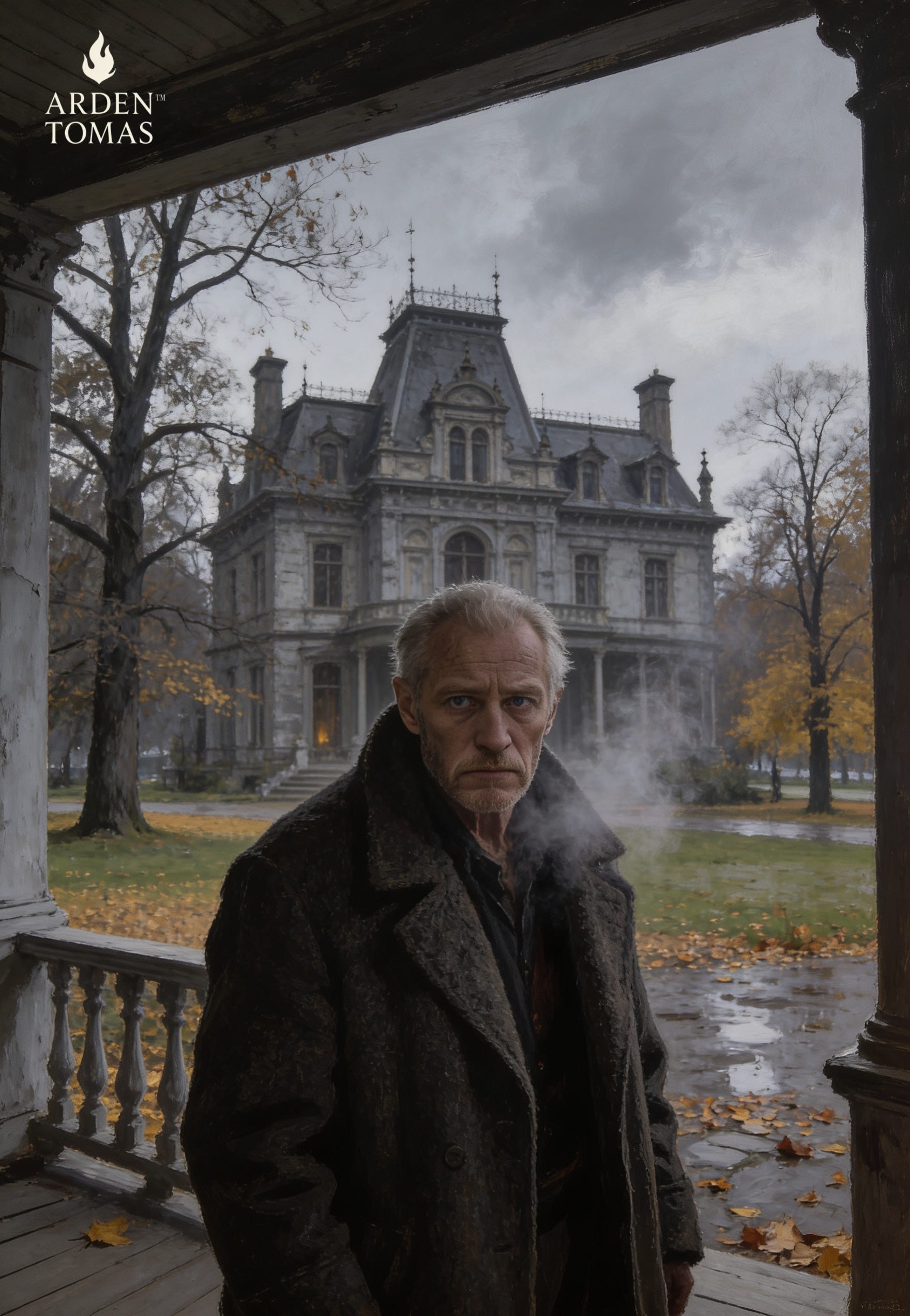
Leo closed the door. The house exhaled. The darkness returned, filling the hallway like water fills a glass, and at the end of it, where the shape had been, Alexander stood. Fully dressed now — for the first time. Dark pants. White shirt. Bare feet on the cold stone. He looked almost human. Almost real. Almost like someone Leo could have met on a street, in a café, in a life that felt increasingly like a dream he had once had.
"Who was that?" Alexander asked. His voice was soft. Gentle. The voice of a lover, not a captor.
"Benedek. The caretaker."
"He worries about you."
"He doesn't know you."
Alexander smiled. He stepped forward. His hand found Leo's — the fingers interlaced, warm and certain and inescapable.
"No one knows me, Leo. Only you. And that is because you made me." He leaned in. His lips touched Leo's ear. His breath was warm — too warm, like the tea, like the stones, like everything in this house that had been heated by something that was not a fire.
"Write something for me," Alexander whispered. "Write me a world. A bigger world. One with no doors. No Benedek. No morning. No end."
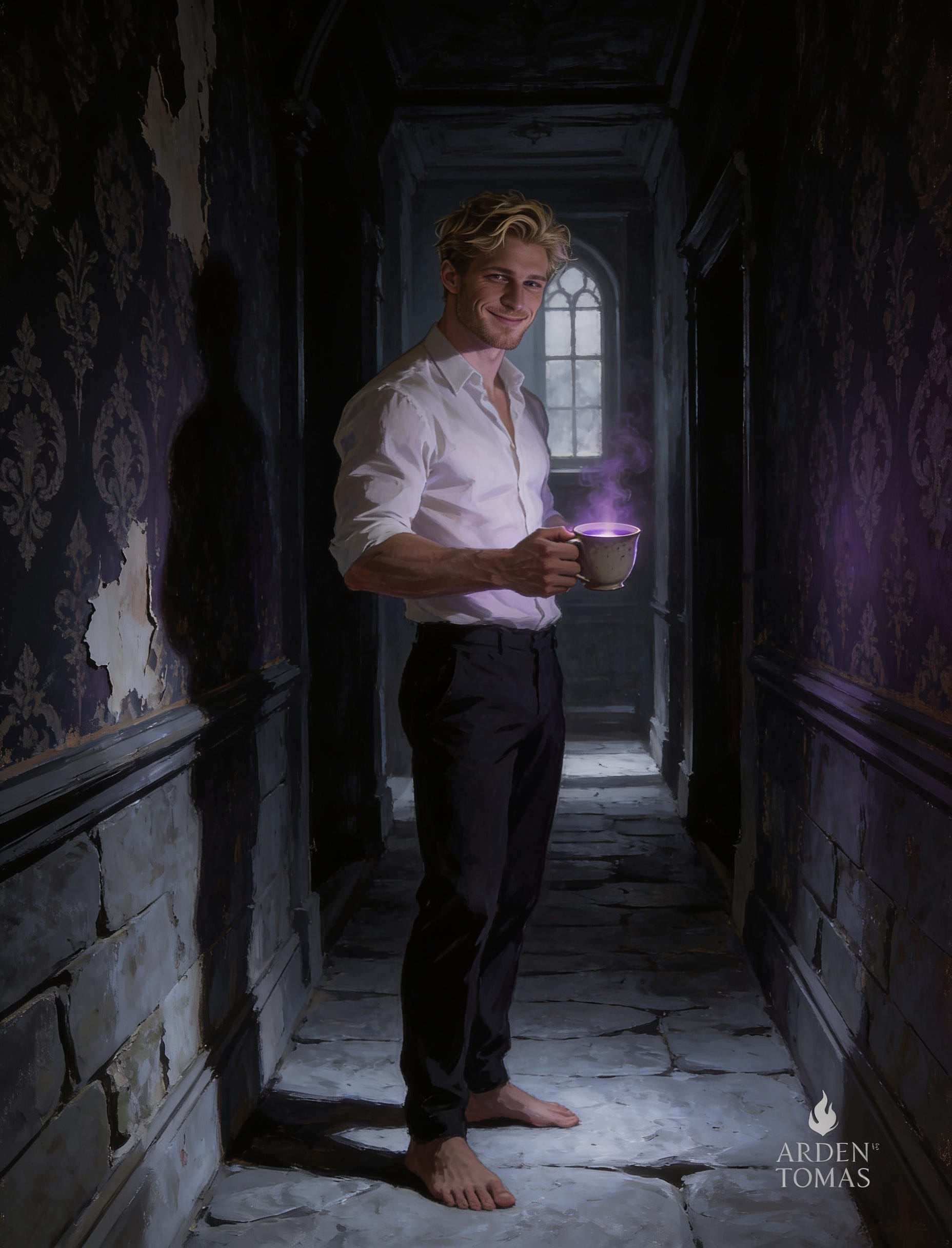
Leo felt the words enter him like the tea had — spreading through his chest, his blood, his bones. Not a command. A suggestion. The gentlest, most loving suggestion a mirror had ever made to the face it reflected.
"All right," Leo said. "I'll write."
Alexander's smile widened. In the dim hallway, in the house that was swallowing itself, in the space between what Leo wanted and what was being taken from him, the smile looked like love. It always did.
Behind the walls, beneath the floor, deep in the cellar where the dark surface waited, something shifted. Not soon anymore.
Now.


He is there but not there, the wall of reality has become hazy!! 😈🤌